




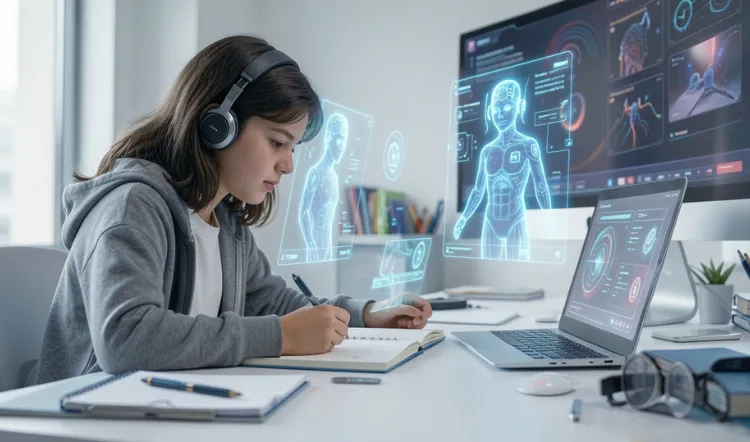
Google is making artificial intelligence a more active part of the learning experience by bringing new study capabilities to Gemini and Search. The company has introduced study notebooks in Gemini that can create personalized lessons based on a learner’s goals, strengths, and knowledge gaps.
The development represents a broader change in how people can use search and AI for education. Instead of simply looking for an answer, learners can increasingly use AI to explore subjects, test their understanding, organize information, and build personalized study experiences.
Consequently, Google is positioning its AI ecosystem as more than a source of information. It is becoming a digital learning environment that can adapt to individual needs.
Study Notebooks Create Personalized Learning
One of the most notable additions is study notebooks within the Gemini app. Students can upload materials such as syllabi, notes, and reading resources before taking a diagnostic quiz that helps identify areas of strength and weakness.
Gemini can then generate short lessons and practice quizzes designed around those knowledge gaps. As students continue learning and completing assessments, the experience can adapt based on their progress.
Moreover, study notebooks are designed to make learning more interactive. Students can ask questions during lessons and work with their uploaded materials rather than relying only on general information from the web.
Search Becomes a More Active Learning Tool
Google is also bringing learning capabilities into AI Mode in Search. Students can create study guides and interactive quizzes through Canvas while using information from the web and uploaded files.
This creates a more flexible research experience. Instead of searching for individual resources and manually organizing them, learners can ask AI Mode to help build a structured learning resource and refine it through follow up questions.
Therefore, Search is gradually moving beyond the traditional model of entering a query and receiving a collection of links. The experience is becoming more conversational, interactive, and personalized.
AI Can Help Identify Knowledge Gaps
A major advantage of these tools is their focus on identifying what a learner does not understand. Traditional study methods often require students to decide which topics need additional attention.
AI can make that process more systematic. A diagnostic assessment can reveal weaker areas, after which the system can generate learning material aimed at those specific gaps.
As a result, students may spend less time reviewing material they already understand and more time working on concepts that require additional attention.
Interactive Quizzes Make Learning More Engaging
Quizzes can turn passive reading into active learning. Google’s new study experiences use practice questions to help students test their understanding and receive feedback.
Furthermore, feedback can provide more than a simple indication of whether an answer is correct. It can help learners understand why an answer is right and where additional study may be useful.
This approach reflects an important technology trend in education. AI is increasingly being used to create interactive experiences rather than simply generate text.
Gemini Connects Learning Across Google Tools
Google is also connecting its learning experiences across the wider Gemini ecosystem. NotebookLM was renamed Gemini Notebook in July 2026, while Google said the research focused product would increasingly work across Gemini and Search. It also introduced code execution capabilities for deeper data analysis.
This integration could make it easier for learners to move between research, note taking, analysis, and AI assisted study.
Meanwhile, the broader Gemini ecosystem is becoming increasingly connected to Google products. This suggests that future learning experiences may depend less on individual applications and more on how effectively different AI services work together.
What This Means for Students
For students, these developments could make studying more personalized and accessible. Instead of starting with a blank page, learners can provide their existing materials and ask AI to help transform them into lessons, quizzes, or study guides.
However, AI should remain a learning aid rather than a replacement for independent thinking. Students still need to evaluate information, understand concepts, practice problem solving, and develop their own judgment.
Consequently, the strongest use of educational AI may be as a companion that supports active learning rather than a shortcut that simply provides answers.
Implications for the IT Ecosystem
The expansion of AI study tools also provides broader technology insights into the evolution of digital platforms. Search engines and AI assistants are increasingly becoming multifunctional environments that combine information retrieval, content generation, personalization, and interactive tools.
IT industry news increasingly reflects this shift toward AI systems that can perform more complex tasks. Education is one example, but similar capabilities are appearing across business research, productivity, customer service, and professional development.
Moreover, these developments could influence HR trends and insights as organizations explore AI powered training and employee learning. Businesses may eventually use similar adaptive systems to create personalized professional development experiences.
Business Opportunities Around AI Learning
The growing use of AI for education could also influence several commercial areas. Marketing teams may use AI powered learning experiences to create educational customer journeys, while businesses can use personalized content to strengthen engagement.
Sales strategies and research could also benefit from AI systems that help teams learn about products, industries, and customer needs more efficiently. Similarly, finance professionals could use adaptive AI tools for training around changing regulations and finance industry updates.
Marketing trends analysis will remain important as organizations explore how educational content can become more interactive and personalized.
Responsible Use of AI in Education
As AI becomes more involved in learning, accuracy and responsible use remain important. Educational content needs to be trustworthy, while students should understand that AI generated information can sometimes contain errors.
Google says its Classroom learning experiences are grounded in course materials and developed with pedagogy and safety experts.
Therefore, responsible implementation should combine AI capabilities with reliable sources, teacher guidance, and critical thinking.
Future Outlook for AI Powered Learning
Google’s expansion of AI study tools suggests that digital learning is moving toward more adaptive experiences. Search can help learners discover information, while Gemini can increasingly organize that information into personalized lessons, quizzes, and research environments.
The most significant opportunity may be the combination of personalization and active learning. Instead of giving every student the same digital experience, AI can potentially adjust explanations and practice according to individual needs.
For technology leaders, educators, and businesses, the broader lesson is clear. AI is evolving from a tool that provides information into a system that can help people understand, practice, analyze, and apply knowledge. Explore more technology insights and emerging digital innovation with BusinessInfoPro.