




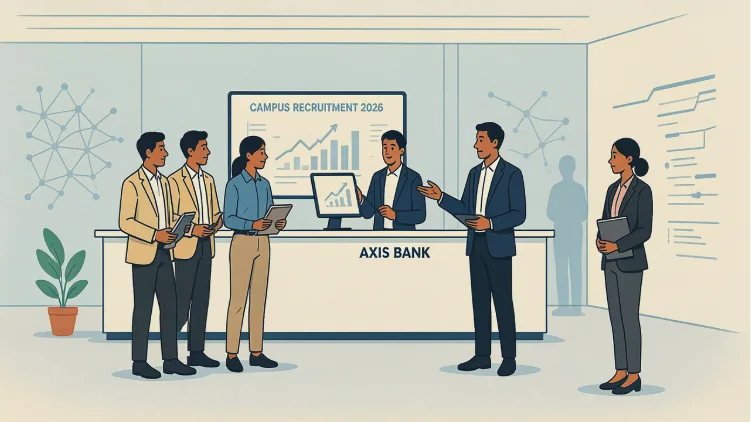
Axis Bank is preparing to increase its campus recruitment during FY27, even as its overall employee strength declined by more than 3,100 during the previous financial year. The bank expects to recruit between 12,000 and 12,500 young professionals from campuses, compared with approximately 11,500 to 11,600 recruits in FY26.
The development highlights an important shift in workforce planning. Rather than simply expanding headcount, the bank is focusing on bringing in young talent, developing skills internally and moving employees toward roles where human judgement and customer interaction remain important.
Workforce Numbers Show a Changing Employment Strategy
Axis Bank ended FY26 with 101,337 employees, compared with 104,453 a year earlier. This represents a reduction of 3,116 employees. However, the decline does not indicate that recruitment activity has stopped. The bank hired 31,665 employees during FY26, demonstrating significant movement across its workforce.
Consequently, the latest figures provide a more complex picture of employment in the banking sector. Companies can continue recruiting while simultaneously changing existing roles, improving productivity and allowing technology to handle repetitive activities.
This is becoming increasingly relevant to HR trends and insights as employers reconsider how they balance recruitment, automation and employee development.
AI Is Changing the Nature of Banking Jobs
Artificial intelligence is playing an increasingly important role in the bank’s workforce strategy. According to Rajkamal Vempati, Group Head of Human Resources at Axis Bank, technology is reducing the need for certain transaction processing and lower level operational activities.
However, the bank’s approach involves redeploying employees before allowing some roles to disappear. As a result, the workforce transition is not simply about reducing jobs. Instead, it involves moving talent toward areas where employees can contribute through customer relationships, specialist knowledge and decision making.
This development also connects with broader Technology insights because businesses across industries are examining how artificial intelligence can automate routine tasks while creating demand for new capabilities.
Customer Facing Roles Gain Importance
As automation takes over selected operational activities, Axis Bank is placing greater emphasis on customer facing and relationship driven functions. Commercial banking, wealth management and the micro, small and medium enterprise segment are among the areas receiving attention.
Relationship management continues to depend heavily on communication, trust and an understanding of customer requirements. Therefore, these capabilities remain valuable even as digital tools become more sophisticated.
The same shift can be observed across the wider financial sector, making the development relevant to Finance industry updates and changing workforce requirements.
Young Talent Remains a Strategic Priority
Despite the reduction in overall workforce numbers, Axis Bank continues to view young professionals as an important source of future talent. The bank’s campus strategy focuses on hiring early career employees, training them and developing their capabilities over time.
Furthermore, only a relatively small portion of the planned campus intake will be dedicated specifically to technology positions. Around 150 to 200 technology professionals are expected among the approximately 12,000 to 12,500 planned campus recruits.
Most new employees are expected to enter business, customer facing, risk, compliance, audit and cybersecurity functions.
Internal Mobility Becomes More Important
Another significant part of the workforce strategy is internal mobility. Axis Bank uses its AI enabled Thrive career platform to match employees with available positions according to their skills.
Employees can now apply for internal opportunities after 16 months, compared with three years previously. According to the bank, around 65 percent of employee movement is now internal, compared with an estimated industry level of 25 to 30 percent.
Meanwhile, the bank’s attrition rate declined to 22.4 percent in FY26 from 25.5 percent in FY25. The bank attributed the change to factors including productivity improvements, new ways of working and greater internal mobility.
AI Tools Are Supporting Employee Productivity
Axis Bank is also using AI to support employees in their existing roles. Its Siddhi platform uses customer information to provide targeted prompts, while other AI enabled tools analyse customer interactions and identify potential areas for improvement.
According to the bank, employees using Siddhi recorded productivity gains of up to three times, while employees participating in daily learning activities were reported to be 10 to 15 percent more productive.
Therefore, the bank’s technology strategy is not focused solely on replacing repetitive work. It also involves giving employees tools that can help them make better use of their time and information.
New Skills and Roles Are Emerging
The changing workforce model is also creating demand for new capabilities. AI governance, data governance and AI centre of excellence functions are examples of areas where organisations may need specialised talent as artificial intelligence becomes more deeply integrated into business operations.
As a result, employees may increasingly need a combination of technical awareness, business knowledge and human skills. Communication, critical thinking, customer understanding and adaptability can become increasingly valuable alongside digital capabilities.
These developments are also relevant to IT industry news because the relationship between technology teams and business functions is becoming increasingly interconnected.
What the Hiring Shift Means for Businesses
The latest hiring strategy at Axis Bank demonstrates how workforce planning can evolve when technology changes the way tasks are performed. More recruitment does not necessarily mean every department will grow at the same pace.
Instead, businesses may recruit heavily in selected areas while reducing reliance on repetitive activities elsewhere. Consequently, HR teams need to consider skills, internal mobility, employee training and technology adoption together rather than treating recruitment as a standalone activity.
The development also has implications for Sales strategies and research because customer facing teams may require stronger relationship management capabilities as automation handles more routine processes.
Similarly, Marketing trends analysis increasingly involves understanding how AI can support employees without removing the human understanding required for customer engagement.
Insights for the Future of HR
The most important insight from the latest development is that workforce transformation is becoming more focused on skills and task redesign. Organisations can continue hiring while simultaneously using AI to change how existing employees work.
For HR leaders, this means workforce planning should consider which activities can be automated, which capabilities need to be developed and where employees can create additional value.
For job seekers and early career professionals, the changing environment also highlights the importance of combining digital awareness with communication, analytical thinking, customer understanding and adaptability.
Ultimately, the Axis Bank example illustrates how recruitment and automation can exist together. The future workforce may not simply be larger or smaller. Instead, it may be structured differently around technology, skills and human expertise.
Reach out to BusinessInfoPro for professional insights that help you understand changing industries and emerging business opportunities.
Source : peoplematters.in