





Transformers have become a foundational technology behind modern artificial intelligence, powering many of the language models, chatbots and generative AI systems businesses increasingly use. Originally introduced to improve machine translation, this neural network architecture has expanded into applications involving text, images, audio, video and complex reasoning.
As companies invest in AI driven automation, understanding transformers is becoming an important part of technology insights and IT industry news. Their ability to process relationships between different pieces of information has helped developers build systems that can generate content, analyse documents and support business decisions.
What Are Transformers in Artificial Intelligence
A transformer is a type of neural network designed to understand relationships within sequences of data. Unlike older approaches that process information primarily in sequence, transformers use a mechanism called attention to determine which parts of an input are most relevant to one another.
For example, when an AI model reads a sentence, attention helps it connect words with their surrounding context. This enables the model to interpret meaning more effectively, even when relevant words appear far apart.
Researchers introduced the architecture in the 2017 paper Attention Is All You Need. The authors demonstrated that transformers could achieve strong machine translation results while supporting more parallelised training than the recurrent neural network approaches commonly used at the time.
How Transformer Architecture Works
Transformers rely on several interconnected components to process and learn from data.
Attention Mechanism
Attention allows a model to assign different levels of importance to different parts of its input. Consequently, a language model can connect a pronoun to an earlier subject or identify relationships between words across a paragraph.
Tokenisation and Embeddings
Before processing text, a model divides it into smaller units called tokens. It then converts these tokens into numerical representations that a neural network can process. Positional information also helps the model understand the order of tokens.
Neural Network Layers
Multiple layers of attention and feed forward processing refine the model’s internal representations. During training, the model learns patterns from large datasets by adjusting its parameters. Once trained, it can use those patterns to generate predictions or produce new content.
Together, these components provide the foundation for many large language models and generative AI applications.
From Chatbots to Multimodal AI
The influence of transformers extends far beyond text generation. Many modern AI systems use transformer based components to support a broad range of tasks.
Language models use them to answer questions, summarise reports, write code and assist with customer support. Meanwhile, multimodal systems can combine information from text, images, audio and other data types, depending on their design.
Google’s research into Titans and the MIRAS framework, published in December 2025, illustrates one important direction for AI development. The researchers explored approaches to improving memory and processing efficiency when models handle extensive context. Their work addresses a recognised challenge because the computational cost of standard attention can rise substantially as input sequences grow longer.
This research highlights a broader industry priority. Developers are working to make AI systems more efficient, capable of handling larger amounts of information and better suited to practical applications.
Why Transformers Matter for Businesses
Transformer powered AI is creating opportunities across several business functions. However, its value depends on the quality of implementation, data and human oversight.
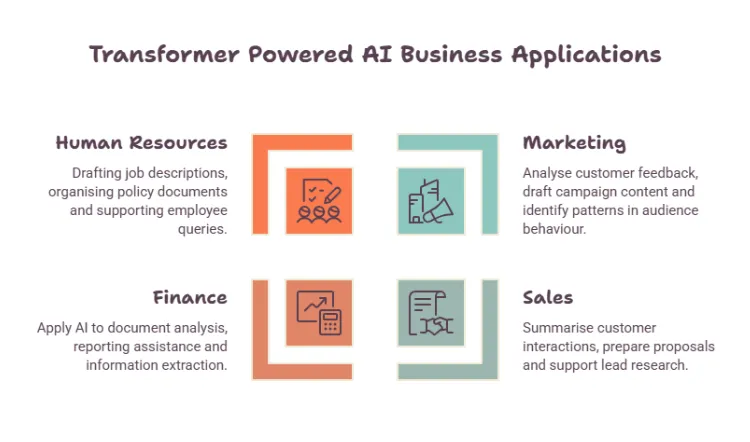
In marketing, AI tools can help analyse customer feedback, draft campaign content and identify patterns in audience behaviour. Sales teams can use these systems to summarise customer interactions, prepare proposals and support lead research.
Finance departments can apply AI to document analysis, reporting assistance and information extraction. In human resources, potential applications include drafting job descriptions, organising policy documents and supporting employee queries.
These developments connect with broader marketing trends analysis, sales strategies and research, HR trends and insights, and finance industry updates. Nevertheless, organisations should evaluate each use case separately rather than assuming that one AI system will deliver the same benefits everywhere.
Efficiency and Scalability Remain Key Challenges
Despite their capabilities, transformers have limitations. Training large models can require substantial computing resources, electricity and specialised hardware. In addition, long input sequences can increase processing costs and response times.
Researchers are exploring more efficient attention mechanisms, improved memory systems and smaller models that can run on less expensive hardware. These approaches could make advanced AI more accessible to smaller companies and support deployment in environments with limited computing capacity.
Furthermore, organisations must consider data privacy, security, factual accuracy and potential bias. Transformer models can generate convincing but incorrect responses, making verification essential for sensitive business decisions.
Key Developments to Watch
• Transformer architecture remains central to many leading language models and generative AI applications.
• Research into longer context windows and improved memory aims to help models process extensive documents and complex information.
• Multimodal AI is expanding the technology’s potential across text, images, audio and video.
• Efficiency improvements could reduce deployment costs and widen access to AI tools.
What Businesses Should Know
Transformers provide a powerful foundation for modern AI, but businesses do not necessarily need to build their own models to benefit from the technology. Existing AI platforms and application programming interfaces can help organisations introduce capabilities into established workflows.
Before adopting a solution, decision makers should identify a clear business objective, assess data protection requirements and measure performance against existing processes. They should also establish human review procedures for important outputs.
Ultimately, the next phase of AI adoption will depend not only on increasingly capable models but also on how responsibly and efficiently organisations apply them. Businesses that combine suitable technology with reliable data and effective oversight will be better positioned to turn AI innovation into measurable value.
Stay informed about emerging AI technologies, business innovation and digital transformation with BusinessInfoPro.com.
Explore our latest technology insights and industry news to understand the developments shaping tomorrow’s business landscape.