





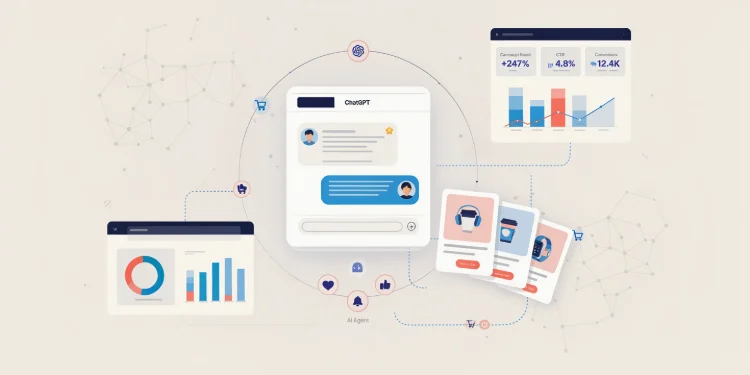
OpenAI is expanding its advertising capabilities as businesses increasingly look toward conversational platforms to reach potential customers. On September 16, 2026, the company announced new AI powered advertising experiences for ChatGPT, including Sponsored Agents and additional tools designed to simplify advertising workflows.
The development represents another step in the evolution of digital advertising. Rather than relying only on traditional advertisements that direct users to external websites, businesses can now experiment with conversational experiences that allow potential customers to ask questions and explore products or services directly.
Consequently, the development could create new opportunities for marketers while also changing how consumers discover brands online.
Sponsored Agents Bring Conversations Into Advertising
Sponsored Agents are being tested with selected advertisers in the United States. When a user interacts with an eligible advertisement, they can choose to begin a clearly identified conversation with an AI representative sponsored by the business.
For example, someone researching a product could ask questions about features, availability or suitability instead of immediately leaving ChatGPT to visit a company website. The conversation can then provide relevant information before directing the customer to the business website when they are ready to continue.
Importantly, OpenAI says Sponsored Agents are separate from ChatGPT’s independent answers and from the original conversation started by the user. This distinction is intended to make the commercial nature of the interaction clear.
AI Changes the Customer Journey
Traditional digital advertising generally follows a familiar path. A person sees an advertisement, clicks it and arrives at a landing page. AI based advertising introduces another stage because the advertisement can become the starting point for an interactive conversation.
As a result, marketers may need to rethink how they approach customer journeys. Instead of focusing exclusively on headlines, images and landing pages, businesses may also need to prepare accurate conversational information about their products.
Furthermore, this approach could make customer questions part of the advertising experience itself. That creates an opportunity for brands to provide more useful information while customers evaluate their options.
This shift is particularly relevant to marketing trends analysis because conversational AI is becoming another environment where consumers research products and services.
New AI Tools for Advertisers
OpenAI is also introducing AI capabilities designed to help businesses create and manage advertisements. According to the company, marketers can use prompts in ChatGPT Work to create advertising materials, while Ads Manager receives additional AI powered creative tools.
In addition, OpenAI has introduced integrations with HubSpot and Shopify. HubSpot users can connect their advertising accounts and manage campaigns while using relevant customer context. Meanwhile, eligible Shopify merchants can connect product catalogs and measurement tools through the ChatGPT Ads application.
Therefore, the broader strategy is not simply about displaying advertisements. It also involves integrating AI into campaign creation, customer engagement, measurement and ecommerce workflows.
What It Means for Digital Marketers
The expansion of ChatGPT advertising could influence several areas of digital marketing. First, marketers may need to create content that works well within conversational environments. Clear product information, accurate descriptions and useful answers could become increasingly important.
Second, campaign measurement may evolve as businesses assess more than clicks and impressions. Engagement with Sponsored Agents could provide another signal for understanding customer interest.
Moreover, sales teams may need to consider how AI conversations influence prospects before they reach a conventional sales channel. This connects directly with sales strategies and research because customers can potentially gather detailed information before contacting a salesperson.
At the same time, marketing teams will need to maintain consistent messaging across advertisements, websites, product catalogs and AI powered customer experiences.
Privacy and User Trust Remain Important
Advertising within an AI assistant also creates questions around privacy and user control. OpenAI states that advertisements are clearly labeled and separate from ChatGPT responses. The company also says advertisers do not receive access to private conversations and that users have control over how their advertising experience is personalized.
OpenAI’s advertising policies also restrict advertising in certain sensitive and unsuitable contexts. The company says these controls are intended to protect users while maintaining brand safety for advertisers.
Nevertheless, businesses adopting AI advertising should continue reviewing privacy practices, customer expectations and applicable regulations.
Broader Business Impact
The development has implications beyond marketing departments. Finance industry updates increasingly involve questions about the measurement and efficiency of technology investments, while HR trends and insights may involve new skills for employees working with AI powered marketing platforms.
Similarly, IT industry news continues to highlight the growing integration of AI into business applications. Technology insights from this shift suggest that marketing platforms are becoming more automated and interconnected.
As these systems develop, companies may increasingly bring marketing, sales, technology and data teams together when planning customer acquisition strategies.
Insights and Actionable Knowledge
Businesses exploring conversational advertising should begin by reviewing their existing product information and customer questions. Clear answers, consistent brand messaging and accurate product data can provide a stronger foundation for AI assisted customer interactions.
Marketing teams should also consider how conversational experiences fit within their existing customer journey. Instead of treating AI advertising as another isolated channel, organizations can evaluate how it connects with websites, CRM platforms, ecommerce systems and sales processes.
Finally, companies should monitor engagement carefully and continue testing whether conversational advertising delivers meaningful business outcomes. The emergence of Sponsored Agents shows that digital advertising is moving toward experiences where discovery, interaction and conversion can happen within a more connected environment.
Connect with BusinessInfoPro to explore emerging opportunities and discover practical insights for navigating the evolving technology and marketing landscape.
Source : media-telecom