





The internet has become one of the most important platforms for independent journalism, public debate and access to information. However, growing government restrictions, online censorship and digital surveillance are creating new challenges for press freedom worldwide. As news organisations increasingly depend on digital platforms to reach audiences, the ability to publish and access information without unnecessary restrictions has become a critical issue.
Recent international reports highlight a continuing decline in internet freedom and growing pressure on journalists. These developments have placed technology companies, governments and media organisations at the centre of an increasingly important debate about digital rights, transparency and independent reporting.
Global Internet Freedom Faces Growing Pressure
According to Freedom House’s Freedom on the Net 2026 report, global internet freedom has declined for the 16th consecutive year. The assessment found that conditions deteriorated in 16 of the 38 countries examined, while only eight recorded improvements.
The report identifies government censorship, restrictions on digital platforms, surveillance and increasingly restrictive internet policies as significant challenges. It also highlights how authorities are attempting to control access to international online services and limit the distribution of independent information.
Meanwhile, Reporters Without Borders reported that more than half of the countries and territories covered by its 2026 World Press Freedom Index now fall into the difficult or very serious categories. Its findings also indicate that legal restrictions have become a particularly concerning obstacle for journalists.
These developments demonstrate that access to digital communication does not automatically guarantee freedom of expression.
India Faces New Challenges Around Online Journalism
India provides an important example of how internet regulation and press freedom intersect. Freedom House’s 2026 assessment classified India as partly free, awarding the country 50 out of 100 points for internet freedom.
The report highlighted internet shutdowns, online content restrictions and government requests to remove digital material as continuing concerns.
Additionally, amendments introduced to India’s Information Technology Rules in February 2026 reduced the compliance window for certain content removal requests from 36 hours to just three hours.
Reporters Without Borders has also raised concerns about the impact of faster content removal requirements on journalistic reporting. According to its reporting, these changes could leave digital platforms with limited time to examine government requests before restricting access to content.
For independent publishers and digital news organisations, the developments underline the importance of transparent moderation procedures and appropriate safeguards for legitimate journalism.
Internet Shutdowns Threaten Access to Information
Internet shutdowns remain another major concern for press freedom. Governments sometimes justify connectivity restrictions on security or public order grounds. However, widespread disruptions can prevent journalists from communicating with sources, publishing verified reports and sharing important developments.
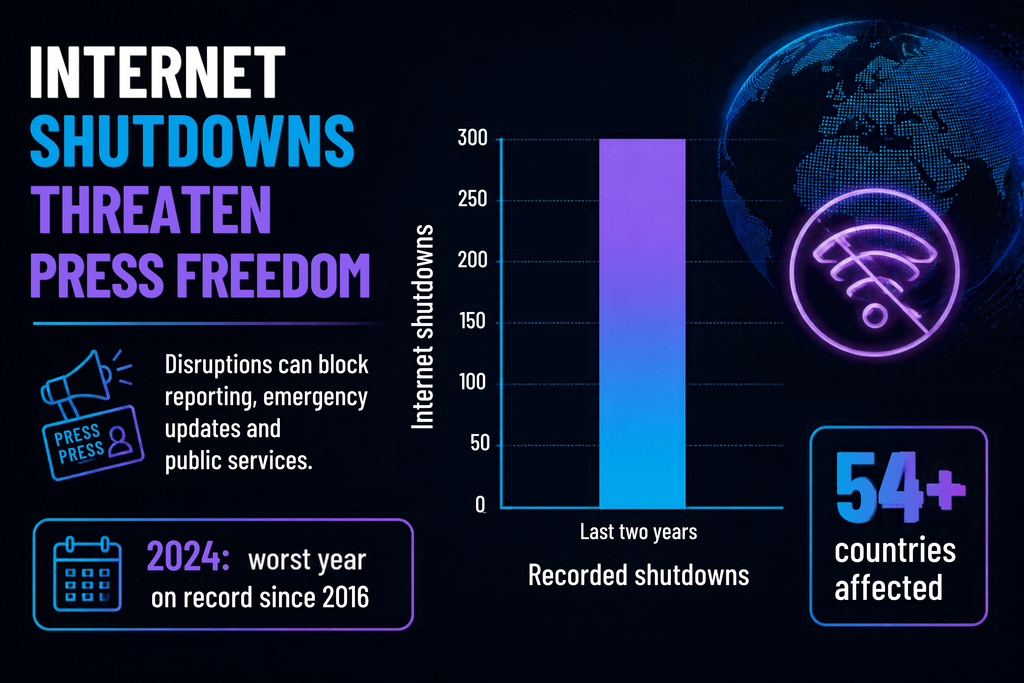
UNESCO has highlighted the growing use of internet shutdowns during political crises and protests. According to its January 2026 statement, at least 300 internet shutdowns were recorded across more than 54 countries over the preceding two years, with 2024 becoming the worst year on record since 2016.
Furthermore, shutdowns affect more than news organisations. Citizens can lose access to emergency updates, public services, educational resources and reliable information during critical situations.
Consequently, maintaining stable internet connectivity is increasingly important for democratic participation and public accountability.
Digital Platforms Must Protect Journalists
Technology companies now play a significant role in determining how information reaches global audiences. Social media networks, search engines and content distribution platforms have become essential channels for news publishers.
However, these platforms also face difficult decisions involving misinformation, harmful content, political pressure and freedom of expression.
A UNESCO and UN Human Rights Office publication released in April 2026 highlighted the risks facing journalists and human rights defenders in digital spaces. The publication reported that 73 percent of women journalists have experienced online threats, while one in four has experienced offline attacks as a result.
Online harassment can discourage journalists from covering sensitive subjects. Moreover, coordinated attacks, manipulated content and threats can create an environment where reporters feel pressured to avoid certain stories.
Platform accountability, transparent moderation policies and stronger journalist protection mechanisms are therefore becoming essential parts of the digital media ecosystem.
Technology and Artificial Intelligence Add New Risks
Artificial intelligence is creating additional opportunities and challenges for independent journalism. Automated content creation, translation and research tools can help publishers improve productivity and reach wider audiences.
However, AI generated misinformation, deepfakes and manipulated media can make it increasingly difficult for audiences to distinguish authentic reporting from fabricated material.
Additionally, digital surveillance and automated content moderation raise questions about privacy, accountability and editorial independence.
For the IT industry, these developments create growing demand for secure communication systems, reliable content verification tools and responsible technology governance.
Media companies must also invest in cybersecurity and digital literacy to protect journalists, sources and audiences.
What Businesses Should Know
The changing relationship between internet access and press freedom has implications beyond the media industry. Businesses increasingly depend on reliable digital communication, online publishing and access to international information networks.
Technology companies must understand how regulatory decisions affect their platforms, customers and business operations. Meanwhile, news publishers need to strengthen cybersecurity, maintain transparent editorial practices and establish alternative communication channels where possible.
Organisations should also monitor regulatory developments across their operating markets and ensure that their content moderation policies respect legitimate expression while addressing genuine safety concerns.
For businesses operating in technology, marketing and communications, an open digital environment supports consumer trust, innovation and access to reliable information.
Ultimately, protecting an independent internet requires cooperation between governments, technology providers, journalists and civil society. The future of press freedom will depend not only on the ability to publish information but also on whether people can access, question and share it without unreasonable interference.
For more updates on technology insights, IT industry news and developments shaping the digital economy, visit BusinessInfoPro.com.
Stay informed with our latest coverage of business, technology, finance and marketing developments.