





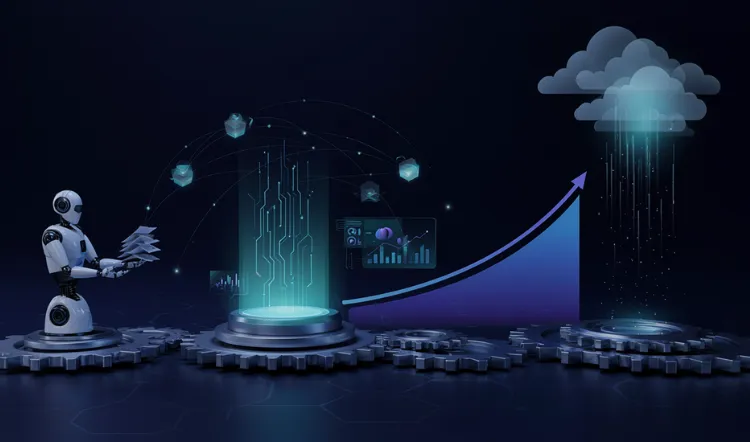
The global Intelligent Process Automation market is entering a period of significant growth as organizations look for better ways to automate repetitive business processes, improve efficiency, and reduce operational costs.
The market is projected to reach $63.85 billion by 2035, highlighting the growing demand for technologies that combine process automation with advanced digital capabilities.
This expansion reflects a broader shift in how organizations approach Automation. Businesses are moving beyond simple rule-based workflows and increasingly adopting intelligent systems that can analyze information, make decisions, and coordinate complex processes.
What Is Intelligent Process Automation?
Intelligent Process Automation combines traditional process automation with technologies that enable systems to handle more complex tasks.
Traditional Automation generally follows predefined rules. For example, a system can automatically send an email after a customer completes a form.
Intelligent Process Automation can go further by incorporating capabilities such as artificial intelligence, machine learning, natural language processing, robotic process automation, and data analytics.
This allows organizations to automate workflows that previously required greater levels of human intervention.
Why Is Automation Becoming More Important?
Businesses across industries are under pressure to improve productivity while controlling costs.
Manual processes can consume employee time, create delays, and introduce errors. As organizations process increasing amounts of digital information, managing these tasks manually becomes increasingly difficult.
Automation provides a way to streamline repetitive activities and allow employees to focus on more strategic responsibilities.
For example, businesses can automate document processing, customer onboarding, invoice management, data entry, employee workflows, and customer service processes.
Intelligent Automation vs Traditional Automation
Traditional Automation works well when processes are predictable and rules are clearly defined.
Intelligent Process Automation is designed to handle more complicated workflows where information may vary and decisions may need to be made based on available data.
For example, a traditional workflow might automatically route an invoice to a specific department based on a fixed rule.
An intelligent system could analyze the invoice, extract information from an unstructured document, identify relevant details, and determine how the document should be processed.
This difference is helping organizations expand their use of Automation beyond simple repetitive tasks.
Key Technologies Behind Intelligent Process Automation
Several technologies contribute to Intelligent Process Automation.
Robotic Process Automation
Robotic Process Automation, or RPA, uses software bots to perform repetitive digital tasks.
Bots can interact with applications, transfer information, process transactions, and execute predefined workflows.
Artificial Intelligence
Artificial intelligence can help automated systems analyze information, recognize patterns, generate recommendations, and support decision-making.
AI can make automated workflows more flexible than traditional rule-based systems.
Machine Learning
Machine learning enables systems to identify patterns in data and improve their performance based on historical information.
This can be useful for tasks such as classification, prediction, fraud detection, and customer analysis.
Natural Language Processing
Natural language processing allows systems to work with human language.
Businesses can use NLP within automated workflows to process documents, analyze customer messages, classify requests, and extract information from text.
Business Process Management
Business Process Management helps organizations model, analyze, optimize, and manage business workflows.
When combined with Automation technologies, BPM can help businesses create more efficient end-to-end processes.
Industries Adopting Intelligent Automation
Intelligent Process Automation has applications across a wide range of industries.
Banking and Financial Services
Financial institutions can use Automation for transaction processing, document verification, customer onboarding, compliance workflows, and fraud monitoring.
Automated processes can help financial organizations manage large volumes of transactions while improving operational efficiency.
Healthcare
Healthcare organizations can automate administrative processes such as appointment scheduling, claims processing, documentation, billing, and patient communication.
Automation can reduce repetitive administrative workloads and allow staff to focus more on patient-related responsibilities.
Retail and Ecommerce
Retail businesses can use intelligent automation for inventory management, order processing, customer support, personalized recommendations, and supply chain operations.
Automated workflows can help retailers respond more quickly to changes in customer demand.
Manufacturing
Manufacturers have long used Automation to improve production processes.
Intelligent systems can now combine industrial automation with data analytics, sensors, predictive maintenance, and intelligent decision-making.
This can help organizations improve production efficiency and reduce equipment downtime.
Telecommunications
Telecommunications companies can automate customer support, network monitoring, billing, service activation, and issue management.
Intelligent automation can help providers manage large customer bases and complex infrastructure.
Benefits of Intelligent Process Automation
The growth of the market is closely connected to the benefits organizations can achieve from intelligent Automation.
Increased Productivity
Automated systems can perform repetitive tasks continuously and consistently.
Employees can spend more time on activities requiring creativity, communication, analysis, and strategic thinking.
Reduced Operational Costs
Automating repetitive processes can reduce the amount of manual effort required to complete routine activities.
Over time, organizations can improve resource utilization and operational efficiency.
Improved Accuracy
Manual data processing can result in errors.
Automated systems can perform repetitive operations according to predefined rules and processes, helping organizations improve consistency.
Faster Processing
Automated workflows can process large volumes of information quickly.
This can help organizations respond faster to customers, employees, suppliers, and business events.
Better Customer Experience
Automation can reduce waiting times and provide faster responses.
For example, automated customer service systems can handle routine questions immediately while routing more complicated issues to human employees.
Automation and Digital Transformation
The growing Intelligent Process Automation market is also connected to broader digital transformation initiatives.
Organizations are increasingly replacing manual and fragmented processes with connected digital workflows.
Instead of automating a single task, businesses are beginning to automate complete processes that may involve several departments and software platforms.
For example, a customer onboarding process can connect marketing, sales, customer relationship management, identity verification, document processing, and customer communication systems.
This creates a more connected approach to Automation.
The Role of Cloud Computing
Cloud computing provides important infrastructure for modern automation platforms.
Cloud-based systems can provide scalable computing resources, centralized data access, application integrations, and automated workflows.
Organizations can use cloud services to deploy automation solutions without maintaining all of the underlying infrastructure themselves.
Cloud platforms can also make it easier to integrate different business applications into automated processes.
Automation and Artificial Intelligence
The combination of Automation and artificial intelligence is creating new opportunities for businesses.
Traditional automation performs tasks according to defined instructions. AI can provide additional capabilities such as language understanding, prediction, classification, and pattern recognition.
When these technologies work together, businesses can create intelligent workflows that respond to changing information.
For example, an automated customer service system can receive a customer message, analyze its meaning, classify the request, retrieve relevant information, and route the issue to the appropriate team.
Challenges of Intelligent Process Automation
Despite its benefits, intelligent Automation also presents several challenges.
Organizations need to carefully identify processes that are suitable for automation.
Poorly designed workflows can produce inefficient results even when the underlying technology works correctly.
Data quality is another important consideration. Intelligent systems depend on reliable information to produce useful results.
Security and privacy must also be considered when automated systems process sensitive business or customer information.
Organizations may also face challenges related to integration, employee training, governance, and the cost of implementing new automation technologies.
How Businesses Can Prepare for Intelligent Automation
Businesses considering intelligent automation should begin by analyzing their existing processes.
The first step is to identify repetitive tasks that consume significant time and have clear rules or measurable outcomes.
Organizations can then determine whether traditional Automation, RPA, AI-enabled systems, or a combination of technologies is most appropriate.
Starting with smaller projects can help businesses understand the benefits and challenges before expanding automation across larger workflows.
Clear governance and monitoring should also be established to ensure automated systems operate as expected.
The Future of Automation
The projected growth of the Intelligent Process Automation market demonstrates how quickly organizations are adopting automated technologies.
The future of Automation is likely to involve increasingly intelligent systems capable of coordinating workflows, analyzing information, and supporting business decisions.
Rather than replacing every human activity, intelligent automation can be used to augment employees by handling repetitive and data-intensive tasks.
Organizations that successfully combine human expertise with automated technology can create more efficient and adaptable operating models.
Conclusion
The projected $63.85 billion Intelligent Process Automation market by 2035 reflects growing demand for technologies that can help businesses automate increasingly complex processes.
Automation is evolving from simple rule-based task execution toward intelligent, connected workflows that can incorporate AI, machine learning, RPA, analytics, and natural language processing.
As businesses continue their digital transformation efforts, intelligent automation can play an important role in improving productivity, reducing operational costs, increasing consistency, and enhancing customer experiences.
However, successful implementation requires more than technology. Organizations need well-designed processes, reliable data, strong governance, appropriate security controls, and employees who can work effectively alongside automated systems.
The companies that approach Automation strategically will be better positioned to take advantage of the growing intelligent process automation landscape through 2035.
Connect with BusinessInfoPro to discover expert perspectives that help businesses make smarter technology decisions with confidence.
News : einnews.com