







AI cybersecurity startup Armadin has reached a valuation of more than $2.5 billion after raising $255.5 million in Series B funding, highlighting growing investor interest in technologies designed to counter increasingly sophisticated cyber threats.
Announced on October 1, 2026, the funding round was co led by Andreessen Horowitz and Accel. Bain Capital Ventures and Redpoint joined as new investors, while existing backers, including Google Ventures, Kleiner Perkins, Menlo Ventures, 8VC, Ballistic Ventures and In Q Tel, also participated.
According to the company, the latest investment brings its total funding to approximately $445 million. The Palo Alto based startup plans to use the capital to expand its security platform, research, training and commercial operations.
The deal underscores a wider shift in technology insights and IT industry news, as businesses look for more advanced ways to identify vulnerabilities before attackers exploit them.
Kevin Mandia Brings Cybersecurity Experience to Armadin
Armadin was founded by Kevin Mandia, a cybersecurity entrepreneur known for establishing Mandiant, the security company that Google agreed to acquire for approximately $5.4 billion in 2022.
Mandia’s experience in incident response and threat intelligence provides important context for Armadin’s approach. Rather than focusing only on detecting known threats, the startup aims to help organizations discover weaknesses that attackers could combine to compromise their systems.
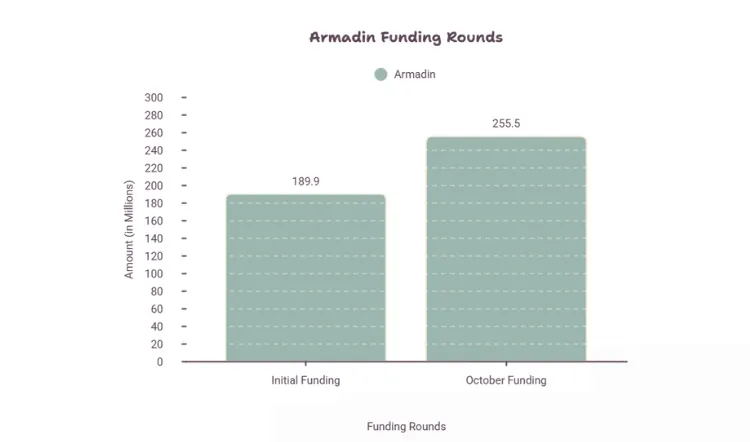
The company emerged publicly in March 2026 with approximately $189.9 million in combined seed and Series A funding. Its subsequent Series B round represents a substantial increase in capital within a relatively short period.
This rapid fundraising reflects investor interest in cybersecurity companies that apply artificial intelligence to practical enterprise security challenges. However, a high private market valuation does not guarantee future commercial success or profitability.
How Armadin Uses AI Agents to Identify Cybersecurity Risks
The company’s technology uses groups of autonomous AI agents to simulate attacker behavior and identify weaknesses across enterprise systems. These agents aim to connect individual vulnerabilities into potential attack paths, helping security teams understand how separate weaknesses could lead to a larger breach.
Traditional penetration testing can provide valuable insights, but it is often conducted periodically. Armadin’s approach is designed to support more continuous security testing, allowing organizations to identify risks as their technology environments change.
In a statement published by Ballistic Ventures in March 2026, Mandia explained the rationale behind the company’s strategy. “When attacks move at machine speed, defense must become autonomous.”
The statement reflects a central concern across the cybersecurity industry. AI tools can help defenders assess threats faster, but attackers may also use similar technologies to automate reconnaissance and exploit vulnerabilities.
Investor Interest Signals Growing Demand for AI Security
Armadin’s funding round highlights the financial opportunities emerging at the intersection of artificial intelligence and cybersecurity. The company raised approximately $189.9 million in its initial combined seed and Series A financing before securing another $255.5 million in October.
With total disclosed funding reaching $445 million, the startup has attracted significant backing from established venture capital firms and investors with experience in technology and national security.
Moreover, the investment reflects a broader business priority. Enterprises increasingly rely on cloud infrastructure, interconnected applications, and AI powered workflows, expanding the number of systems security teams must protect.
However, funding alone does not establish whether a cybersecurity platform can consistently reduce breaches or deliver measurable savings. Customers will ultimately need evidence of effectiveness, manageable implementation costs, and reliable integration with existing security operations.
What the Valuation Means for the Cybersecurity Industry
The valuation places Armadin among the closely watched emerging companies developing AI based security technologies. Its progress could encourage further investment in autonomous vulnerability discovery, automated penetration testing, and continuous security assessment.
For enterprise customers, these tools could help prioritize weaknesses according to their practical exploitability rather than treating every security alert as equally urgent. Consequently, security professionals may be able to focus more time on remediation and strategic risk management.
Nevertheless, autonomous security systems introduce their own challenges. Organizations must control testing permissions, protect sensitive information, validate AI generated findings, and ensure automated activities do not disrupt production systems.
The expansion of AI driven security also has implications for hiring and workforce development. Cybersecurity professionals will continue to need expertise in threat analysis, system architecture, incident response, and AI governance, even as automation changes routine tasks.
What Businesses Should Know
Armadin’s latest funding demonstrates growing investor confidence in cybersecurity solutions designed for an era of increasingly automated attacks. Its long term success will depend on how effectively its technology identifies meaningful risks, supports remediation, and delivers measurable value to customers.
Businesses evaluating AI security platforms should examine independent validation, integration requirements, data protection controls, and the quality of reported findings before committing to a deployment. They should also retain human oversight for critical security decisions.
As AI adoption accelerates, continuous security testing could become an increasingly important part of enterprise risk management. However, organizations should treat autonomous tools as part of a broader security strategy rather than a replacement for established controls and experienced professionals.
For more updates on technology insights, cybersecurity developments, and finance industry updates, visit BusinessInfoPro.com.