







India’s corporate advance tax collections recorded strong growth in the 2026 to 2027 financial year, highlighting continued momentum in tax revenues. Meanwhile, Securities Transaction Tax collections remained significantly higher than a year earlier, supported partly by changes in tax rates on derivatives transactions.
According to government data reported on October 15, 2026, India’s net direct tax collections reached ₹13.37 lakh crore as of October 14, representing a 13.2 percent year on year increase. The figures reflect stronger corporate tax contributions, although growth across different taxpayer categories remained uneven.
The latest figures also highlight the importance of tax revenues for government finances, public expenditure and economic planning.
Corporate Advance Tax and Direct Tax Collections
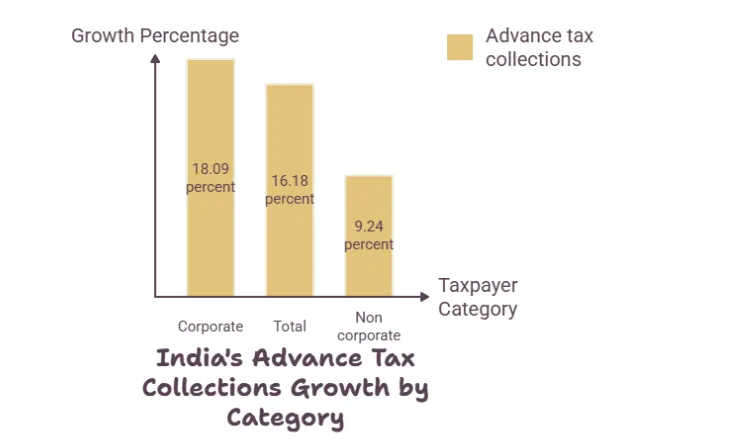
Corporate taxpayers continued to drive a substantial share of India’s direct tax revenue growth. Earlier figures released by the Income Tax Department showed that corporate advance tax collections rose 18.09 percent to approximately ₹4.16 lakh crore by September 17, compared with the corresponding period in the previous financial year.
Total advance tax collections increased 16.18 percent to ₹5.22 lakh crore during the same period. Non corporate advance tax payments grew at a slower rate of 9.24 percent to approximately ₹1.06 lakh crore.
Furthermore, net corporate tax collections reached ₹5.99 lakh crore by October 14, registering annual growth of around 21 percent, according to the latest reported figures.
These numbers suggest that corporate contributions remain an important driver of tax revenue growth. However, advance tax receipts alone do not provide a complete picture of corporate profitability because payments also depend on tax liabilities, payment schedules and adjustments.
Securities Transaction Tax Collections Surge
Securities Transaction Tax collections also recorded significant growth. As reported by Moneycontrol on October 15, STT receipts reached ₹46,840 crore by October 14, an increase of approximately 51 percent compared with the previous year.
The increase followed changes to STT rates on specified derivatives transactions that took effect on April 1, 2026.
The government increased the STT rate on futures transactions from 0.02 percent to 0.05 percent. The rate on the sale of options rose from 0.10 percent to 0.15 percent of the option premium, while the rate on exercised options increased from 0.125 percent to 0.15 percent of intrinsic value.
Consequently, the increase in STT revenue reflects the combined influence of revised tax rates and trading activity. It should not automatically be interpreted as evidence of a comparable increase in stock market turnover.
Expert Views on Tax Revenue Growth
Tax professionals have highlighted the need to distinguish between revenue growth driven by economic activity and growth resulting from tax policy changes.
According to reporting by NDTV Profit on September 18, Deloitte India partner Rohinton Sidhwa said the increase of more than 50 percent in STT collections appeared to be driven primarily by rate hikes introduced in the Budget rather than an increase in turnover.
Meanwhile, stronger corporate tax receipts indicate that businesses continue to make substantial contributions to public finances. However, the sustainability of this growth will depend on corporate earnings, economic conditions, investment activity and subsequent tax payments.
Impact on Businesses and Financial Markets
Higher corporate tax collections can reflect stronger taxable profits and a broader contribution from businesses. Moreover, consistent tax receipts can help the government finance infrastructure, public services and other spending commitments.
For companies, the figures reinforce the importance of accurate financial forecasting, tax compliance and advance tax planning. Businesses must assess their expected taxable income carefully to avoid underpayment and potential interest liabilities.
For investors and traders, higher STT collections carry a different implication. Increased transaction taxes can raise trading costs, particularly for participants who frequently trade derivatives. Consequently, market participants may need to reassess their trading strategies and transaction expenses.
These developments also matter for Finance industry updates, particularly for tax advisers, brokerage firms and financial planning professionals monitoring regulatory changes.
What Businesses Should Know
India’s rising direct tax collections offer a useful indicator of revenue momentum, but the underlying figures require careful interpretation.
Businesses should review projected profits, maintain accurate tax records and make advance tax payments within applicable deadlines. Finance teams should also account for tax policy changes when preparing budgets and cash flow forecasts.
Meanwhile, investors should consider the revised STT rates when calculating the cost of futures and options transactions. Stronger tax receipts do not necessarily mean that every business sector or market participant is experiencing equal growth.
The next tax collection updates will help establish whether the current momentum continues through the remainder of FY27.
Stay informed about finance, business developments and economic policy with BusinessInfoPro.com.
Visit BusinessInfoPro.com for timely reporting and practical insights that help businesses make informed decisions.
Source : financialexpress.com