



Artificial intelligence is changing how software as a service companies protect applications, customer data, and cloud infrastructure in 2026. Security teams are increasingly using AI to detect suspicious activity, investigate threats, and automate routine tasks. However, cybercriminals are also using AI to develop more convincing phishing attacks and accelerate the discovery of software vulnerabilities.
The growing adoption of AI is pushing SaaS providers to strengthen security controls while maintaining reliable services. Consequently, businesses are focusing on faster threat detection, improved access management, and stronger oversight of AI powered tools.
2026 Cybersecurity Reports Highlight Growing AI Risks
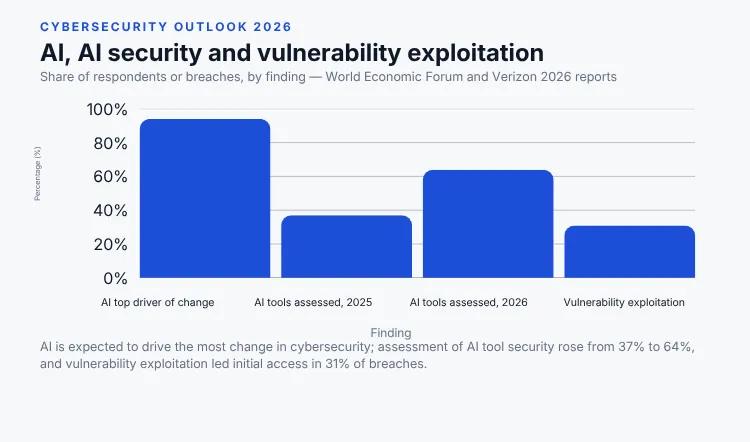
The World Economic Forum’s Global Cybersecurity Outlook 2026 identifies AI as a major driver of change in cybersecurity. Its survey found that 94 percent of respondents expected AI to be the most significant driver of change in cybersecurity during the year.
Furthermore, the report found that the share of organizations assessing the security of their AI tools increased from 37 percent in 2025 to 64 percent in 2026. This growth highlights the increasing recognition that AI systems require dedicated security assessments.
Meanwhile, Verizon’s 2026 Data Breach Investigations Report found that vulnerability exploitation accounted for 31 percent of breaches in its reporting dataset. This made software vulnerabilities the leading initial access method in the report.
These findings underline the challenge facing SaaS companies. Although AI can strengthen security operations, organizations must also address vulnerable software, exposed credentials, and weaknesses across third party services.
AI Improves Threat Detection and Incident Response
Traditional cybersecurity tools often depend on predefined rules and known attack patterns. AI powered systems can analyze large volumes of security data to identify unusual behavior and potential threats that might otherwise escape attention.
For SaaS providers, these capabilities can support several important security functions.
- Anomaly detection helps identify unusual login attempts, unexpected data transfers, and suspicious account activity.
- Automated investigation helps security teams examine alerts and prioritize incidents based on potential risk.
- Threat intelligence analysis helps identify emerging attack patterns across security logs and network activity.
- Faster response allows approved systems to isolate suspicious sessions, block malicious activity, or trigger additional authentication checks.
Moreover, automation can reduce repetitive work for security analysts. However, organizations should retain human oversight for sensitive actions, particularly when a response could interrupt critical business applications or affect legitimate customer accounts.
Cybercriminals Are Also Using Artificial Intelligence
AI creates opportunities for defenders, but it also gives attackers new ways to target businesses. Cybercriminals can use generative AI to produce convincing phishing messages, impersonate trusted individuals, and adapt social engineering campaigns to specific victims.
SaaS businesses face additional risks because their platforms often connect customer accounts, payment systems, business applications, and external integrations. A compromised account or vulnerable software component can expose information across interconnected services.
IBM’s 2026 Cost of a Data Breach Report identified a growing impact from AI driven attacks. Its global findings reported an average data breach cost of approximately 4.99 million US dollars, an increase of 12 percent from the previous year.
The report also highlighted the financial benefits of security automation. Organizations that extensively used AI and automation in security operations saved an average of 1.93 million US dollars per breach compared with organizations that did not use these capabilities.
These figures demonstrate the potential value of AI assisted defense. Nevertheless, automation cannot eliminate the need for secure software development, regular patching, and well tested incident response procedures.
SaaS Providers Must Address New AI Security Risks
As SaaS companies introduce AI assistants, automated agents, and intelligent integrations, their security responsibilities are expanding. These systems may access confidential documents, customer records, internal databases, and third party applications.
Gartner identified agentic AI oversight as a key cybersecurity trend for 2026. AI agents can introduce additional attack surfaces when they receive excessive permissions or act without sufficient supervision.
Additionally, poorly controlled AI tools may expose confidential information through unauthorized access, insecure integrations, or the misuse of sensitive prompts. Businesses must therefore establish clear rules for data access, model usage, and automated decision making.
Effective safeguards include least privilege access, encryption, multifactor authentication, regular security testing, and monitoring of AI activity. Furthermore, companies should evaluate external AI vendors before connecting them to sensitive systems.
What Businesses Should Know
SaaS companies should treat AI cybersecurity as an ongoing operational priority rather than a one time technology investment. The following measures can help organizations reduce risk while adopting new capabilities.
- Review AI access permissions and limit each system to the information and actions it genuinely needs.
- Strengthen identity security with multifactor authentication, role based access controls, and continuous monitoring.
- Patch vulnerabilities promptly and test applications, APIs, and third party integrations regularly.
- Establish AI governance policies covering sensitive data, approved tools, employee usage, and automated actions.
- Prepare incident response plans that address AI related attacks, compromised accounts, and accidental data exposure.
- Measure security performance using detection times, response times, vulnerability remediation, and incident outcomes.
For technology leaders, these priorities also influence purchasing decisions, operational budgets, and customer trust. Strong cybersecurity can help SaaS businesses protect their reputation while supporting sustainable growth.
Stay Informed With BusinessInfoPro
Follow BusinessInfoPro for the latest technology insights, IT industry news, and analysis of emerging cybersecurity developments.
Visit BusinessInfoPro.com for more business news, technology updates, and practical industry insights.