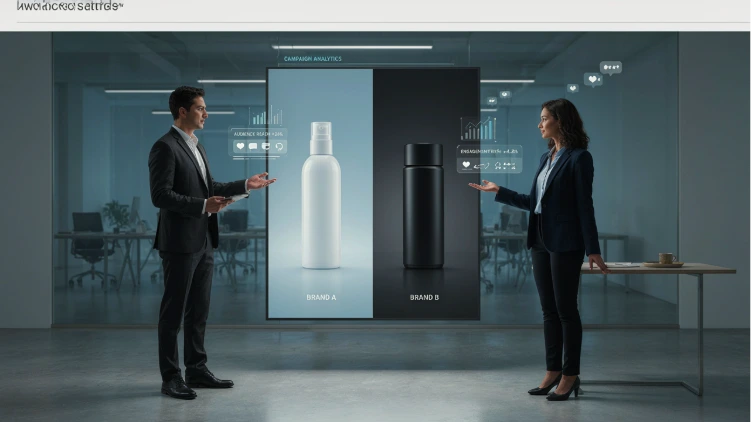






AI can analyze large amounts of customer data, identify behavioral patterns, automate repetitive marketing tasks, and help teams personalize interactions at scale. For SaaS organizations, these capabilities can make Digital Marketing more efficient, measurable, and responsive.
Why Digital Marketing Matters for SaaS Companies
SaaS businesses typically rely heavily on digital channels to attract prospects and convert them into customers. Websites, search engines, social media, email campaigns, webinars, online communities, and paid advertising all play important roles in the customer journey.
Unlike traditional software sales, SaaS marketing often needs to support customers throughout a longer lifecycle. Marketing teams must attract potential buyers, educate them, encourage product adoption, and support expansion opportunities.
This makes Digital Marketing a continuous process rather than a campaign that ends after a purchase.
AI Is Changing SaaS Customer Research
Understanding the target audience is fundamental to effective Digital Marketing.
AI can analyze customer interactions, website behavior, search trends, survey responses, CRM information, and other signals to help marketers understand what prospects need.
Instead of relying only on broad demographic segments, SaaS marketers can develop more detailed audience profiles based on interests, behaviors, business needs, and engagement patterns.
These insights can help companies create more relevant marketing experiences.
AI-Powered Content Creation
Content remains an important component of SaaS Digital Marketing.
AI tools can assist marketers with generating content ideas, creating initial drafts, summarizing research, developing campaign variations, and adapting content for different channels.
However, effective SaaS content still requires human expertise.
AI-generated material needs editorial review to ensure accuracy, originality, brand consistency, and genuine value for the target audience. Companies that combine AI efficiency with human expertise can produce content at greater scale without sacrificing strategic quality.
Personalization at Scale
Personalization has become an important expectation for digital customers.
AI allows SaaS companies to analyze customer behavior and deliver more relevant content and messaging.
A visitor researching a specific software feature may receive different content from someone comparing pricing plans. Similarly, an existing customer may receive educational content related to features they have not yet adopted.
AI can help marketers automate these experiences across large audiences.
AI and SEO
Search engine optimization remains an important part of SaaS Digital Marketing, but the search landscape is evolving.
AI can help marketers analyze search intent, identify content opportunities, understand topic relationships, and optimize content structures.
Rather than focusing exclusively on individual keywords, SaaS companies can use AI to develop broader topic strategies that answer the questions customers are asking throughout the buying journey.
High-quality content, strong expertise, useful information, and a clear understanding of customer intent remain essential.
Smarter Paid Advertising
Paid advertising can become expensive when campaigns are not properly optimized.
AI can analyze campaign performance across audiences, creative variations, keywords, placements, and conversion signals.
Marketing teams can use these insights to identify which combinations are generating better results and allocate budgets more effectively.
AI can also support the creation and testing of different ad variations, allowing marketers to experiment more efficiently.
AI-Powered Email Marketing
Email remains an important channel for SaaS companies.
AI can help marketers determine which messages should be sent, when they should be delivered, and which customer segments are most likely to respond.
For example, a SaaS company could create different email journeys for new leads, trial users, active customers, and customers showing signs of reduced engagement.
This makes email marketing more relevant while reducing the need for manual campaign management.
Predictive Analytics for Demand Generation
Demand generation teams need to identify where future pipeline opportunities are likely to come from.
AI can analyze historical campaign performance, website engagement, account activity, and other signals to identify patterns associated with high-quality leads.
This can help marketers prioritize accounts and channels that show stronger potential.
Predictive insights can also support revenue forecasting and campaign planning, creating closer alignment between marketing and sales.
Improving Conversion Rates
Generating traffic is only part of the marketing challenge.
SaaS companies also need to convert visitors into leads, trials, demos, and customers.
AI can analyze user journeys and identify potential conversion barriers. Marketers can use these insights to test different landing-page structures, calls to action, messaging, and content experiences.
AI can also help identify behavioral patterns among users who eventually convert, providing insights that can inform future optimization efforts.
AI and Customer Retention
Digital Marketing does not end when a customer subscribes.
SaaS companies can use customer behavior data to create marketing campaigns designed to increase engagement and adoption.
AI can identify customers who may not be using important features and trigger educational campaigns or personalized recommendations.
This creates an opportunity for marketing teams to contribute to customer retention and expansion rather than focusing only on acquisition.
Social Media Marketing and AI
Social media continues to influence SaaS brand awareness, thought leadership, and customer engagement.
AI can help marketing teams analyze conversations, identify emerging topics, generate content variations, and understand audience engagement.
However, authentic communication remains important.
SaaS brands should use AI to improve efficiency while maintaining a distinctive human voice. Over-automated content can make a brand feel generic, particularly in competitive technology markets.
Measuring Digital Marketing Performance
AI is also changing how SaaS companies evaluate marketing performance.
Instead of looking only at surface-level metrics such as impressions, clicks, or website traffic, marketers can connect campaign activity with pipeline, customer acquisition, revenue, and retention.
This creates a clearer picture of which marketing activities contribute to business growth.
Marketing teams can then make decisions based on business outcomes rather than vanity metrics.
Challenges of AI in Digital Marketing
AI provides significant opportunities, but SaaS companies also need to manage its risks.
Poor-quality data can produce unreliable insights. Excessive automation can create generic customer experiences. AI-generated content can contain errors or lack originality.
Privacy is another important consideration. Marketers must handle customer information responsibly and ensure that data collection and personalization practices follow applicable privacy requirements.
Human oversight should therefore remain an important part of AI-powered Digital Marketing.
Building an AI-Driven Digital Marketing Strategy
SaaS companies do not need to automate every marketing activity at once.
A better approach is to identify areas where AI can create measurable value. Content research, customer segmentation, campaign analysis, lead scoring, personalization, and reporting can all provide potential starting points.
Companies should establish clear goals and measure whether AI adoption actually improves marketing performance.
The strongest strategy combines AI-powered automation with human creativity, strategic thinking, and customer understanding.
The Future of Digital Marketing for SaaS
AI will continue to influence Digital Marketing as SaaS companies gain access to more sophisticated analytics and automation capabilities.
Marketing teams will increasingly use AI to understand customer intent, personalize experiences, optimize campaigns, forecast demand, and measure revenue impact.
At the same time, human creativity and strategic judgment will remain important differentiators.
The SaaS brands that succeed will not necessarily be those using the most AI. They will be the companies that use AI intelligently while continuing to provide useful, trustworthy, and customer-focused experiences.
Conclusion
AI is transforming Digital Marketing for SaaS companies by improving personalization, content production, campaign optimization, customer analysis, demand generation, and performance measurement.
The technology gives marketing teams the ability to process more information and automate more activities than ever before. But successful marketing still depends on understanding customers and creating experiences that provide genuine value.
In 2026, SaaS companies that combine AI-powered capabilities with strong strategy, high-quality content, and human creativity can build more efficient marketing programs and create stronger connections with their audiences.
Connect with BusinessInfoPro to discover valuable insights, industry analysis, and innovative perspectives that help your organization stay ahead in a rapidly changing world.