





Salesforce has unveiled Koa, its first customer relationship management reasoning model, at Dreamforce 2026, marking a significant development in enterprise artificial intelligence. Developed in collaboration with NVIDIA, the model aims to help AI agents handle complex business tasks involving sales, customer service and other customer relationship management workflows.
Announced on September 15, 2026, Koa is built on NVIDIA Nemotron 3 Super and designed to support multi step reasoning, tool selection and decision making. The launch reflects Salesforce’s broader strategy to move beyond conventional CRM software towards AI agents that can perform tasks across business systems.
The announcement comes as companies increasingly explore AI to improve productivity, automate repetitive work and strengthen customer relationships.
How Salesforce AI CRM Model Koa Works
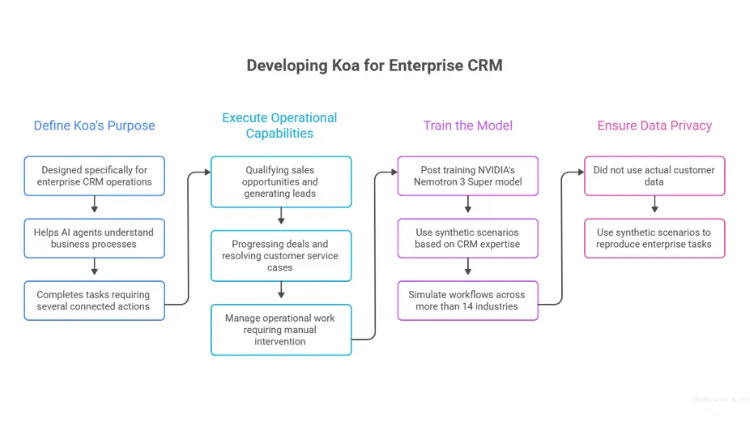
Koa is designed specifically for enterprise CRM operations rather than general purpose conversations. It aims to help AI agents understand business processes and complete tasks that require several connected actions.
These capabilities include qualifying sales opportunities, generating leads, progressing deals and resolving customer service cases. Consequently, businesses could use AI agents to manage more of the operational work that traditionally requires repeated manual intervention.
Salesforce developed Koa by post training NVIDIA’s Nemotron 3 Super model with synthetic scenarios based on nearly three decades of CRM expertise. According to the companies, the training scenarios simulate business workflows across more than 14 industries, including manufacturing, financial services, healthcare and travel.
Importantly, Salesforce says it did not use actual customer data to train Koa. The model’s training corpus consists of synthetic scenarios designed to reproduce enterprise tasks and decision making processes.
Salesforce and NVIDIA Highlight Enterprise Security
Data protection remains a major consideration as organisations introduce AI into systems containing sensitive customer and financial information.
Salesforce says it controls Koa’s model weights and operates the model within its own infrastructure. The company also states that customer data does not cross its trust boundary during training or inference.
This approach is intended to give enterprises greater control over how AI interacts with business information. Moreover, it could help organisations assess AI adoption in regulated sectors where privacy, governance and access controls are particularly important.
Marc Benioff, chair and chief executive officer of Salesforce, described the model’s enterprise focus in the company’s announcement.
“That’s a different kind of intelligence, and it runs entirely inside your trust boundary.”
The statement highlights Salesforce’s emphasis on combining specialised AI reasoning with enterprise security requirements.
What the Launch Means for Sales and Customer Service
The introduction of Koa could influence how businesses organise their sales and service operations.
Sales teams may use AI agents to identify qualified prospects, analyse opportunities and coordinate follow up activities. Meanwhile, customer service teams could benefit from agents capable of handling more complex cases through structured workflows.
Furthermore, businesses may be able to reduce the time employees spend updating records, collecting information and coordinating routine tasks. This could allow staff to concentrate on customer relationships, negotiations and decisions requiring human judgement.
However, these outcomes will depend on implementation quality, data accuracy and the ability of AI agents to perform reliably in real business environments.
For marketing teams, similar developments could support better customer segmentation and campaign coordination when connected CRM information is available and properly governed. These applications also connect with broader marketing trends analysis and sales strategies and research.
Koa Availability and Industry Implications
Salesforce initially announced Koa for selected pilot customers within its Agentforce platform, with general availability expected in winter 2026 in United States regions.
The initial rollout will give selected organisations an opportunity to evaluate the model’s performance in practical enterprise workflows before wider adoption.
The launch also strengthens Salesforce’s collaboration with NVIDIA, combining specialised CRM knowledge with NVIDIA’s model technology and accelerated computing capabilities.
For the wider technology sector, the announcement demonstrates a growing focus on AI models designed for specific business functions. Rather than relying exclusively on general purpose models, software providers are developing systems tailored to particular workflows, security requirements and operational objectives.
Nevertheless, businesses will need to evaluate performance, operating costs, integration requirements and human oversight before deploying these systems at scale.
What Businesses Should Know
Salesforce’s Koa announcement signals a shift towards AI agents that can reason through business processes and execute connected tasks within enterprise systems.
Businesses considering adoption should evaluate three important factors.
- Data governance
Confirm how customer information is accessed, processed and protected during AI operations. - Business performance
Measure improvements in task completion, response times, accuracy and employee productivity against existing workflows. - Human oversight
Establish approval processes for sensitive decisions, customer communications and actions that could affect revenue or compliance.
Although specialised AI models could make CRM operations more efficient, successful adoption will require reliable data, clear governance and measurable business outcomes.
As the technology develops, companies will need to balance automation opportunities with security, accountability and customer trust.
For more updates on artificial intelligence, enterprise software and emerging technology, visit BusinessInfoPro.com.
Follow BusinessInfoPro for the latest technology insights, IT industry news and business developments.
Source : indianexpress.com