




The next phase of artificial intelligence development may depend less on how many tokens a model can process and more on what it can remember. As AI agents take on complex, multi step responsibilities, developers are increasingly focusing on persistent memory, selective information retrieval and the ability to learn from previous interactions.
The approach challenges the idea that expanding context windows is enough to improve AI performance. Instead of repeatedly loading large volumes of conversation history into a prompt, memory enabled agents can retain important information and retrieve it when a task requires it.
This shift is becoming an important development in the technology industry. It could help AI systems move beyond isolated interactions and support continuous workflows across business operations.
Why Token Maximization Is Reaching Its Limits
Large context windows allow AI models to process extensive documents, conversations and technical information. However, larger context does not automatically guarantee better reasoning or more reliable results.
Loading unnecessary information can increase processing costs, introduce distractions and make relevant details harder to retrieve. Furthermore, long running tasks often extend beyond a single conversation or session.
Traditional approaches frequently rely on summarizing previous interactions or repeatedly providing background information. Although useful, these methods can lose important details and struggle to maintain continuity.
Agentic memory offers another approach by allowing systems to decide what information deserves to be stored, updated, retrieved or discarded.
Major Developments Driving Agentic Memory
Several developments demonstrate how the industry is moving toward more sophisticated memory systems.
In September 2025, Anthropic introduced context editing and a memory tool for its Claude Developer Platform. The memory tool allows agents to maintain information in persistent files across sessions. Developers can implement storage and retrieval through their own infrastructure. This enables agents to access relevant knowledge without keeping every previous interaction in the active context window.
OpenAI also announced a significant memory development on June 4, 2026. Its Dreaming update introduced a more capable architecture designed to synthesize memories in the background, improving freshness, continuity and relevance across conversations.
Meanwhile, academic research is exploring more autonomous memory management. A 2026 paper published in the Association for Computational Linguistics introduced AgeMem, a framework that integrates short term and long term memory management into an agent’s decision making process.
The research allows agents to determine when to store, retrieve, summarize, update or remove information. Its experiments across five long horizon benchmarks reported improvements over existing memory augmented approaches.
Research Highlights and the Growing Importance of Memory
Research published by Microsoft Research in May 2026 further illustrates the potential of structured memory. Its proposed architecture combines memory consolidation, forgetting mechanisms, knowledge graphs and retrieval techniques.
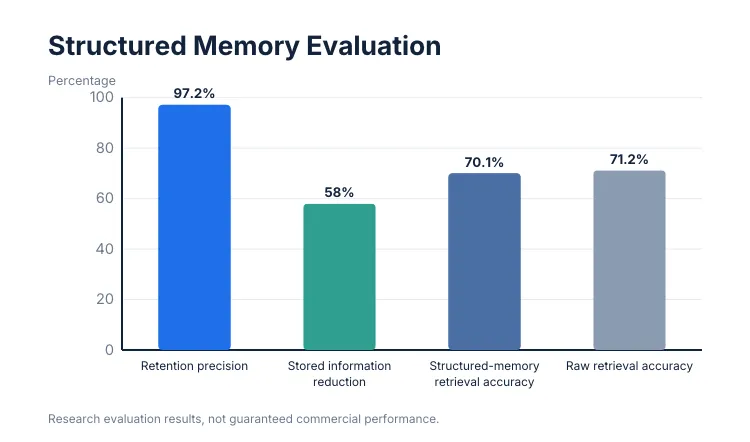
In one software issue tracking evaluation involving 13,000 issues and 120,000 events, the researchers reported 97.2 percent retention precision alongside a 58 percent reduction in stored information. On a separate personal conversation benchmark, the system achieved 70.1 percent retrieval accuracy compared with 71.2 percent for raw retrieval at a 200,000 token context budget.
These findings suggest that carefully managed memory can reduce storage requirements while maintaining useful information. However, they represent specific research evaluations rather than guaranteed results across commercial AI systems.
Additionally, the introduction of AMA Bench at the 2026 International Conference on Machine Learning highlights growing interest in evaluating memory through realistic agent interactions rather than conversation history alone.
How Agentic Memory Could Transform Business Operations
The development has implications across several industries.
Technology and IT operations: AI agents could maintain project documentation, remember previous troubleshooting decisions and retrieve technical knowledge across development sessions. This could improve continuity in software development and IT support.
Human resources: HR agents could use structured organizational knowledge to support recruitment workflows, employee queries and administrative processes. Appropriate access controls would remain essential when handling employee information.
Finance: Memory enabled agents could retain relevant reporting context, previous analysis and business assumptions. This could support financial research and recurring reporting tasks, subject to verification and regulatory requirements.
Sales and marketing: Agents could maintain customer interaction history, campaign preferences and previous research. Consequently, sales teams could receive more consistent support, while marketing teams could build workflows that account for earlier campaign performance.
These applications connect with broader HR trends and insights, finance industry updates, sales strategies and research, and marketing trends analysis.
Challenges That Could Slow Adoption
Despite the potential, persistent memory introduces important challenges.
Data privacy and security are major concerns because agents may retain sensitive business information across sessions. Companies must establish clear rules governing what gets stored, who can access it and when information should be deleted.
Memory accuracy is another concern. Outdated information, conflicting records and incorrect retrieval can influence an agent’s decisions. Moreover, systems need effective mechanisms for updating knowledge and distinguishing reliable facts from temporary instructions.
Cost and performance also matter. Storing information indefinitely is not practical. Businesses need efficient retrieval, summarization and deletion processes to keep memory systems manageable.
What Businesses Should Know
The transition beyond token maximization represents an important direction in AI development. Larger context windows will continue to matter, but they are only one part of building capable autonomous systems.
Businesses evaluating AI agents should examine their ability to retain relevant knowledge, retrieve information accurately, maintain continuity and operate securely across multiple sessions.
Furthermore, organizations should prioritize measurable performance rather than relying on claims about memory capabilities. Real world testing, access controls and reliable data management will be essential before deploying these systems at scale.
Agentic memory could become a foundational capability for the next generation of AI applications. The competitive advantage may increasingly come from systems that know what to remember and when to use it, rather than simply processing more tokens.
For more updates on emerging technologies and business developments, visit BusinessInfoPro.com.
Explore our latest technology insights, IT industry news and business research to stay informed about developments shaping the future of work.
Source : venturebeat.com