


Artificial intelligence is entering a new phase of development as advances in autonomous systems, robotics, generative AI and machine learning reshape how businesses operate. Over the next decade, these technologies are expected to influence industries ranging from healthcare and finance to manufacturing, marketing and transportation.
The latest Stanford Institute for Human Centered AI 2026 AI Index Report highlights the growing influence of artificial intelligence. According to the report, organizational AI adoption reached 88 percent, while generative AI reached 53 percent population adoption within three years.
Moreover, researchers and technology companies are moving beyond conventional AI applications towards systems that can reason, complete complex tasks and interact with the physical world. These developments could significantly change the global technology landscape by 2036.
1. Agentic AI and Autonomous Systems
Agentic AI is emerging as one of the most important developments in artificial intelligence. Unlike traditional chatbots that primarily respond to instructions, AI agents can plan activities, use digital tools and complete multiple tasks with limited human intervention.
Businesses are exploring these systems for customer support, software development, sales operations, financial analysis and workflow automation.
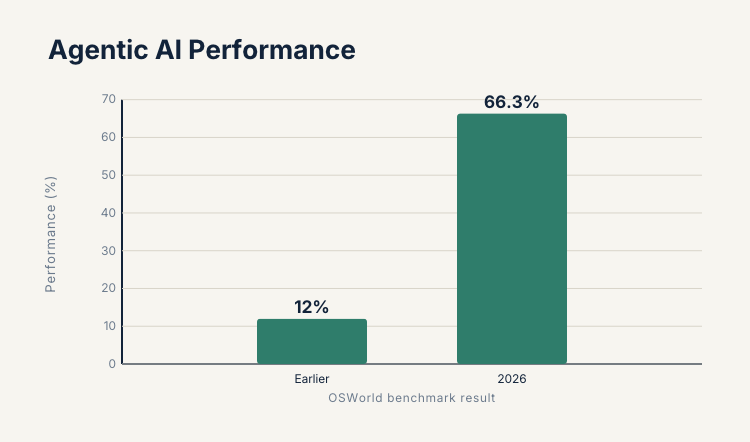
Furthermore, the Stanford 2026 AI Index Report found that AI agent performance on the OSWorld computer task benchmark increased from approximately 12 percent to 66.3 percent. However, these systems still face reliability challenges when handling complex tasks.
Over the next decade, autonomous AI agents could become increasingly common across enterprise software and business operations.
2. Multimodal Artificial Intelligence
Multimodal AI allows systems to understand and process different types of information, including text, images, audio and video.
This technology is changing how people interact with digital platforms. For example, users can provide an image, ask questions about its contents and receive contextual explanations through a single AI system.
Additionally, multimodal applications are gaining attention in healthcare, education, marketing and customer service.
In the coming years, businesses could use these technologies to analyze video meetings, interpret documents, understand customer interactions and generate personalized content. Consequently, multimodal AI may become a standard feature of digital products.
3. AI Powered Robotics and Physical AI
Robotics is entering a new stage as artificial intelligence improves how machines understand their surroundings and perform physical activities.
Physical AI combines machine learning, computer vision, sensors and robotics to help machines interact with real environments.
Manufacturing companies already use intelligent robots for repetitive production activities. Meanwhile, research into humanoid robots is expanding their potential applications in logistics, warehouses, healthcare and industrial operations.
However, real world performance remains a significant challenge. Stanford’s 2026 AI Index Report highlights that robots succeed in only 12 percent of tested real household tasks, despite much stronger results in controlled simulations.
This gap demonstrates why further research and development will be necessary before robots can reliably perform complex everyday activities.
4. AI in Healthcare and Drug Discovery
Healthcare is another industry where artificial intelligence could deliver significant long term changes.
AI systems can help researchers analyze medical images, identify potential disease patterns and accelerate the development of new medicines. Furthermore, machine learning can support scientific research by identifying relationships across large biological datasets.
Drug discovery is particularly promising because traditional research and testing processes can require considerable time and resources.
Over the next decade, AI could improve medical research, support personalized treatment decisions and help healthcare professionals manage administrative workloads.
Nevertheless, clinical validation, patient privacy and regulatory approval will remain essential before AI applications become part of routine medical care.
5. Quantum Computing and AI Integration
Quantum computing is an emerging technology that uses principles of quantum mechanics to process information differently from conventional computers.
Researchers are exploring how quantum systems could support complex scientific calculations, material discovery, optimization and certain machine learning applications.
However, practical quantum computing remains at an early stage. Current systems face challenges involving errors, stability and scalability.
Over the next decade, advances in quantum hardware and software could create new opportunities for scientific research and specialized business applications. However, widespread commercial adoption will depend on meaningful improvements in performance and reliability.
6. Edge AI and Intelligent Devices
Edge AI allows artificial intelligence models to operate directly on local devices rather than depending entirely on cloud computing infrastructure.
This approach can reduce response times, improve privacy and support applications where continuous internet connectivity is unavailable.
Smartphones, industrial equipment, connected vehicles and wearable devices are potential beneficiaries.
Moreover, advances in smaller AI models and specialized processors are making it increasingly practical to run intelligent applications on everyday hardware.
As a result, businesses could deploy AI powered devices across manufacturing, transportation, retail and healthcare operations.
7. AI in Cybersecurity and Digital Protection
As businesses become more dependent on digital infrastructure, cybersecurity threats are also becoming more sophisticated.
AI is increasingly being used to identify suspicious activities, analyze network behaviour and detect potential security incidents.
Furthermore, intelligent security systems can help organizations process large volumes of security information and prioritize potential threats.
However, cybercriminals can also misuse AI to improve phishing campaigns, automate attacks and create convincing fraudulent content.
Consequently, future cybersecurity strategies will require advanced AI detection systems, stronger authentication methods and continuous human oversight.
How Emerging AI Technologies Will Impact Businesses
The next decade could bring significant changes to business operations as organizations integrate intelligent systems into their existing processes.
Some important areas of impact include
- Finance through automated financial analysis, fraud detection and risk management.
- Marketing through personalized campaigns, predictive analytics and content automation.
- Human Resources through recruitment assistance, workforce planning and employee analytics.
- Sales through intelligent lead generation, customer insights and automated communication.
- Technology through AI assisted software development, cybersecurity and infrastructure management.
These developments will also create demand for professionals with expertise in artificial intelligence, data analysis, automation and digital transformation.
What Businesses Should Know
Emerging AI technologies present significant opportunities, but successful adoption will require more than purchasing new software.
Organizations should identify processes where AI can deliver measurable improvements, invest in employee training and establish clear policies for data security and responsible AI usage.
Moreover, businesses should evaluate the reliability, cost and long term value of AI solutions before integrating them into critical operations.
The next 10 years will likely bring substantial technological changes. Companies that combine human expertise with reliable AI systems will be better positioned to adapt to changing market conditions.
For more Technology insights, IT industry news and business developments, visit BusinessInfoPro.com.
Source : medium.com