







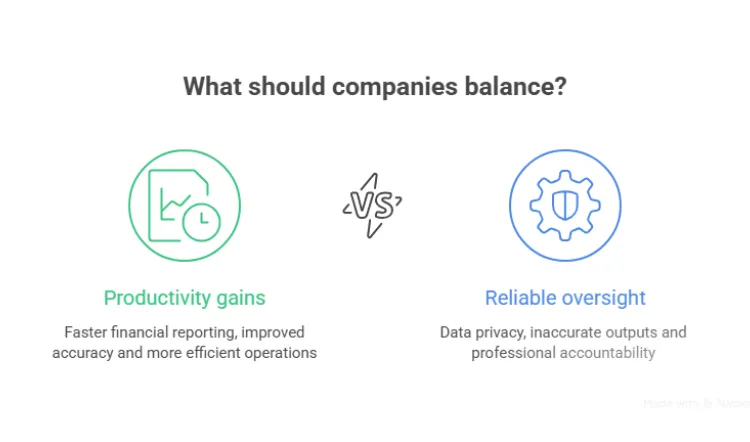
Artificial intelligence is reshaping accounting as businesses seek faster financial reporting, improved accuracy and more efficient operations. From invoice processing to fraud detection, AI powered systems are helping finance teams automate repetitive tasks and analyse financial information.
However, these benefits come with concerns about data privacy, inaccurate outputs and professional accountability. As companies introduce AI into financial workflows, they must balance productivity gains with reliable oversight and compliance.
A March 2026 study commissioned by the Institute of Chartered Accountants of Scotland found that 74 percent of surveyed accounting professionals said generative AI helped speed up their tasks. However, 72 percent expressed concern about errors or incorrect decisions. The findings highlight both the potential and the limitations of the technology.
How AI Is Changing Accounting Operations
Traditional accounting involves transaction recording, invoice verification, bank reconciliation and financial reporting. AI tools can assist with these activities by extracting information from documents, classifying transactions and identifying unusual patterns.
Meanwhile, generative AI can help accountants summarise reports, draft financial explanations and search internal documentation. Machine learning systems can also support forecasting by analysing historical financial data.
However, AI does not automatically guarantee accurate results. Accountants must verify calculations, review supporting documents and ensure that financial records follow applicable accounting standards.
Major Benefits of AI in Accounting
Faster Financial Processes
AI can reduce the time employees spend on repetitive administrative tasks. For example, automated invoice processing can extract supplier information, identify payment amounts and direct documents through approval workflows.
Consequently, finance teams may process more transactions while reducing manual data entry. The actual savings depend on the software, existing systems and quality of financial records.
Improved Error Detection and Fraud Monitoring
AI systems can flag duplicate invoices, unusual payments and inconsistencies across financial records. These capabilities help finance teams identify transactions that require additional investigation.
Furthermore, automated monitoring can support internal controls by highlighting patterns that traditional checks might overlook. However, a flagged transaction does not necessarily indicate fraud and requires appropriate human review.
Better Financial Planning
AI powered analytics can help businesses evaluate spending, forecast cash flow and compare potential financial scenarios. These insights can support budgeting decisions and help managers identify emerging financial pressures.
Additionally, finance teams can use analytical tools to understand revenue patterns and assess the potential effects of changing costs. Nevertheless, forecasts remain dependent on reliable data and reasonable assumptions.
More Strategic Work for Accountants
Automation can allow accountants to devote more time to financial analysis, business planning and advisory services.
This shift also increases the importance of digital skills, critical thinking and professional judgement. Businesses adopting these technologies must therefore consider employee training alongside software investment.
These developments are increasingly relevant to Finance industry updates and wider Technology insights as organisations modernise their financial operations.
Key Risks Businesses Must Address
Data Privacy and Cybersecurity
Accounting systems contain sensitive information, including payroll records, tax documents, supplier details and confidential financial statements. Sharing this information with unauthorised AI platforms can create serious security risks.
Businesses should evaluate vendor security, data retention policies and access controls before adopting new tools. Employees also need clear guidance on which information they can share with external AI services.
Inaccurate Outputs and Misleading Results
Generative AI can produce convincing answers that contain incorrect information. It may misinterpret financial figures, overlook exceptions or provide outdated guidance.
Therefore, businesses should verify AI generated calculations, financial reports and tax related information before relying on them. Professional review remains essential for important financial decisions and regulatory submissions.
Compliance and Accountability
AI adoption does not remove a company’s responsibility to meet applicable accounting, tax and reporting requirements.
Organisations should maintain audit trails, document significant decisions and assign responsibility for reviewing automated outputs. These controls help businesses investigate errors and demonstrate how financial decisions were made.
Implementation Costs and Skills Gaps
Introducing AI may require software subscriptions, system integration, staff training and workflow changes. Smaller businesses must assess whether the expected benefits justify these costs.
Moreover, employees need the skills to identify unreliable outputs and use automation appropriately. Without adequate training, businesses risk introducing new errors while attempting to improve efficiency.
What Industry Experts Say About AI in Accounting
In its 2026 Future of Professionals report, Thomson Reuters highlighted the growing importance of professional AI tools in accounting and auditing.
Elizabeth Beastrom, President of Tax, Audit and Accounting Professionals at Thomson Reuters, said, “accounting and audit firm employees increasingly see professional grade AI tools as a non negotiable part of their jobs.”
The report draws attention to changing expectations across the profession. Firms face growing pressure to adopt useful AI capabilities while maintaining quality, professional standards and client trust.
Meanwhile, the ICAS research indicates that faster individual tasks do not necessarily translate into substantial improvements in overall work rates. This suggests that successful adoption requires effective workflows, suitable technology and human supervision rather than automation alone.
What Businesses Should Know
Businesses should begin by identifying repetitive accounting activities that could benefit from automation, such as invoice processing, document classification and reconciliation support.
They should test tools using appropriately protected data, establish clear review procedures and measure results against processing times, error rates and operating costs.
Additionally, organisations should train employees to assess AI outputs critically and protect confidential financial information. Regular reviews can help ensure that automated processes remain reliable as business requirements change.
The future of accounting will depend on combining technological efficiency with professional expertise. Companies that adopt AI responsibly can improve financial workflows while maintaining the oversight needed to protect accuracy, compliance and trust.
For more updates on finance, business technology and emerging industry developments, visit BusinessInfoPro.com.
Stay informed with professional reporting and practical insights that help modern businesses make better decisions.