



Problem solving skills for modern professionals are gaining importance as businesses navigate rapid technological change, evolving customer expectations and increasingly complex workplace decisions. From managing digital transformation to resolving operational challenges, employees are expected to identify problems, evaluate information and develop practical solutions that support business objectives.
Artificial intelligence is also changing how professionals approach everyday challenges. While AI tools can accelerate research and automate routine analysis, employees still need critical thinking, sound judgment and communication skills to evaluate recommendations and make responsible decisions. Consequently, employers increasingly need people who can combine technical knowledge with creative thinking and practical problem solving.
Workplace Skills in Demand Amid Technological Change
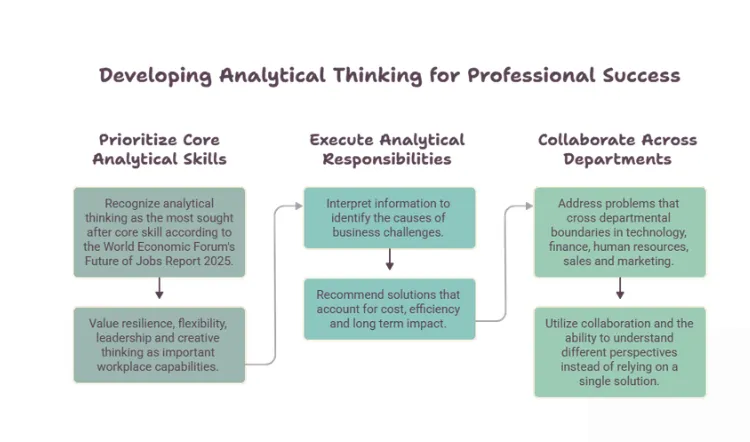
The growing emphasis on analytical thinking reflects broader changes in the global employment market. The World Economic Forum’s Future of Jobs Report 2025 identifies analytical thinking as the most sought after core skill among employers. The report also highlights resilience, flexibility, leadership and creative thinking as important workplace capabilities.
These findings reflect the changing nature of professional responsibilities. Employees must increasingly interpret information, identify the causes of business challenges and recommend solutions that account for cost, efficiency and long term impact.
Furthermore, professionals working in technology, finance, human resources, sales and marketing often face problems that cross departmental boundaries. Resolving them requires collaboration and the ability to understand different perspectives rather than relying on a single solution.
How AI Is Changing Professional Decision Making
AI powered tools are transforming how companies gather information, identify patterns and evaluate potential solutions. In technology teams, these tools can help developers investigate errors and assess technical alternatives. Finance professionals can use analytical systems to identify unusual transactions, while marketing teams can examine campaign performance and customer behaviour.
However, faster analysis does not automatically produce better decisions. AI generated recommendations may contain errors, overlook important context or reflect incomplete information. Professionals therefore need to verify results, question assumptions and consider ethical and commercial consequences before acting.
Moreover, effective problem solving involves understanding when technology can help and when human judgment remains essential. Employees who can combine digital tools with critical thinking are better positioned to respond to unexpected challenges and changing business requirements.
The Business Impact of Strong Problem Solving Skills
Strong problem solving capabilities can improve productivity, reduce avoidable mistakes and support more consistent decision making. When employees identify the underlying cause of a problem instead of treating only its visible symptoms, organisations can reduce repeated disruptions and make better use of resources.
In human resources, these capabilities can help managers address workplace conflicts, improve employee experiences and evaluate staffing challenges. In finance, they support risk assessment, budget planning and the investigation of unexpected costs. Sales teams can use structured analysis to understand declining conversion rates, while marketing professionals can identify why campaigns fail to reach their intended audiences.
Additionally, technology teams benefit when employees investigate root causes before implementing fixes. This approach can help prevent recurring technical issues and improve the reliability of digital services.
The benefits extend beyond individual performance. Teams that share information, evaluate alternatives and learn from unsuccessful decisions can develop more adaptable working practices. As a result, problem solving becomes an organisational capability rather than an isolated individual skill.
Practical Ways Professionals Can Improve Their Skills
Professionals can strengthen their problem solving abilities through regular practice and structured decision making. The first step is to define the problem clearly and distinguish verified facts from assumptions. Without an accurate understanding of the issue, even a well executed solution may fail to address the real cause.
Next, employees should gather relevant evidence, identify possible causes and compare alternative approaches. Techniques such as root cause analysis, the five whys method and basic data analysis can help make this process more systematic.
Furthermore, discussing challenges with colleagues can reveal information that an individual may overlook. Teams should consider potential risks, implementation costs and measurable outcomes before selecting a solution.
After implementation, professionals should review the results against the original objectives. This final step helps establish whether the solution worked and what can be improved in future situations. Over time, learning from both successful and unsuccessful decisions builds confidence and adaptability.
What Businesses Should Know
Employers should treat problem solving as a core workforce capability when hiring, training and evaluating employees. Qualifications and technical expertise remain important, but professionals must also demonstrate how they approach unfamiliar situations, respond to setbacks and justify their decisions.
Businesses can encourage these behaviours through practical training, cross functional projects, mentoring and workplace scenarios that reflect real operational challenges. Managers should also create an environment where employees can raise concerns, question assumptions and discuss mistakes constructively.
As AI adoption expands and business conditions continue to change, analytical thinking, creativity and sound judgment will remain important to effective professional performance. Organisations that develop these capabilities can improve decision quality while preparing their teams for future workplace demands.
For more updates on workplace development, HR trends and insights, technology insights and business strategy, visit BusinessInfoPro.com.
Stay informed with the latest industry news and practical insights to support smarter professional and business decisions.