




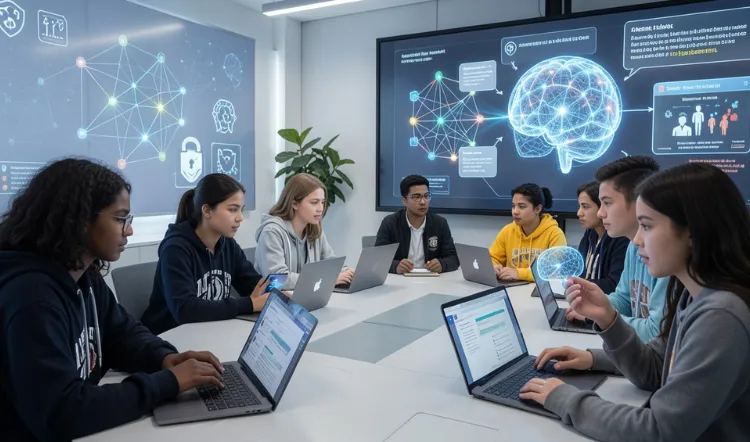
Artificial intelligence is rapidly becoming part of education, employment, and everyday life. Students are learning how to use generative AI tools for research, writing, coding, analysis, and creative projects. However, knowing how to operate an AI system is only one part of becoming prepared for an AI driven future.
The growing importance of accountable AI literacy highlights a deeper need. Students must understand how AI produces information, where it can fail, how its decisions can affect people, and why human judgment remains essential.
This shift is particularly important as organizations across industries adopt intelligent technologies. Students entering the workforce will need technical confidence alongside critical thinking, ethical awareness, and the ability to question automated outcomes.
Understanding Responsible AI Use
AI literacy should go beyond learning prompts and discovering productivity shortcuts. Students need to understand the difference between using AI effectively and using it responsibly.
For example, an AI system can generate an impressive response that contains inaccurate information. Therefore, students should learn how to verify important claims rather than accepting every output as fact.
Similarly, AI systems can reflect limitations in the data and processes used to develop them. Understanding these limitations helps students become more thoughtful technology users.
Moreover, responsible AI education can encourage students to recognize when human expertise is more appropriate than automated assistance.
Building Critical Thinking With AI
One of the biggest educational opportunities created by AI is the chance to strengthen critical thinking. Instead of treating technology as an answer machine, students can use it as a tool for questioning ideas, comparing perspectives, and exploring possibilities.
However, this requires students to remain actively involved in the learning process. If AI completes every difficult task, learners may miss opportunities to develop reasoning and problem solving skills.
Consequently, schools and universities need to encourage students to explain their decisions, verify information, and evaluate AI generated content. These habits can help learners become more independent and confident thinkers.
Why Accountability Matters in Education
Accountability becomes especially important when AI is used for assignments, research, applications, or professional projects. Students should understand that using an AI tool does not remove responsibility for the final result.
If an AI system produces incorrect information, the person submitting that information remains responsible for checking it. Therefore, education should emphasize verification, transparency, and appropriate attribution when AI contributes to academic work.
This approach can also prepare students for professional environments where AI assisted decisions may affect customers, employees, finances, and business operations.
Preparing Students for the Modern Workplace
Employers are increasingly looking for people who can work effectively with emerging technologies. Nevertheless, technical familiarity alone may not be enough.
Students will need to understand how AI fits into broader business processes. They may encounter automated recruitment systems, intelligent customer service platforms, predictive analytics, AI powered financial tools, and automated marketing systems.
These developments connect directly with HR trends and insights because employers are reconsidering which skills will matter most in an AI enabled workplace. Employees who can question technology, identify risks, and communicate effectively with both people and intelligent systems can bring additional value.
AI Literacy Across Business Functions
The need for responsible AI knowledge extends across almost every industry. Finance professionals may work with systems that analyze transactions, assess risks, or support forecasting. Therefore, understanding AI limitations can complement awareness of finance industry updates.
Sales professionals may use AI to research customers, personalize communication, and identify opportunities. Combining technological knowledge with sales strategies and research can help teams use automation without losing the human element of relationship building.
Marketing professionals are also adopting AI for content creation, customer analysis, and campaign optimization. As marketing trends analysis increasingly focuses on automation and personalization, marketers need to understand how data and algorithms influence customer experiences.
Meanwhile, IT professionals will need deeper knowledge of security, data governance, system reliability, and AI integration. This makes technology insights increasingly valuable for students preparing for technical careers.
Teaching Students to Question AI Outputs
A strong AI education should encourage curiosity rather than blind trust. Students should be comfortable asking whether an AI response is accurate, complete, biased, relevant, and appropriate for the situation.
For instance, when using AI for research, students can compare generated information with reliable sources. When using AI for coding, they can test the output rather than assuming that the code is correct.
Additionally, students should understand that different AI systems can produce different answers. This reinforces the importance of evaluation and evidence.
As a result, AI becomes a learning partner rather than a replacement for learning itself.
The Role of Schools and Universities
Educational institutions have an important role in developing responsible AI habits. Simply providing access to AI tools is not enough. Students need guidance on privacy, academic integrity, misinformation, bias, intellectual property, and appropriate use.
Teachers can incorporate AI evaluation into existing subjects instead of treating AI literacy as a completely separate discipline. Students studying business, science, communications, finance, or technology can learn how AI affects their specific fields.
Furthermore, educators can create learning environments where students discuss both the opportunities and limitations of AI. This balanced approach can make technology education more practical and relevant.
Building a More Prepared Generation
Accountable AI literacy can help students move from passive technology consumption toward informed participation. They can learn not only how to use intelligent systems but also how to question them, supervise them, and understand their wider consequences.
The future workplace will likely reward people who can combine technical knowledge with judgment. Students who develop these capabilities early can become better prepared for changing professional expectations.
Technology will continue to evolve rapidly. Therefore, the most valuable skill may not be knowing how to use one particular AI platform but knowing how to learn, evaluate, adapt, and remain responsible as new systems emerge.
Practical Insights for Students and Educators
The central lesson is that AI education should focus on capability and responsibility together. Students should learn how to use AI efficiently while developing the judgment needed to verify information and recognize potential risks.
Educators can support this process by encouraging research, experimentation, discussion, and verification. Students can strengthen their own AI literacy by treating generated information as something to evaluate rather than automatically accept.
Businesses can also contribute by communicating the skills they expect from future employees. When education and industry work together, students can develop a more realistic understanding of how AI will influence professional life.
Ultimately, accountable AI literacy is about preparing people to remain responsible decision makers in an increasingly automated world. The goal is not to make students dependent on AI but to help them become capable professionals who know when, why, and how to use it wisely.
Explore more technology insights and IT industry news with BusinessInfoPro for practical perspectives on the technologies shaping modern business.