




Artificial intelligence is moving beyond individual chatbots and isolated automation tools. Businesses are increasingly exploring systems where multiple intelligent agents can collaborate, exchange information, and complete different parts of a larger workflow. This emerging approach is known as AI agent orchestration.
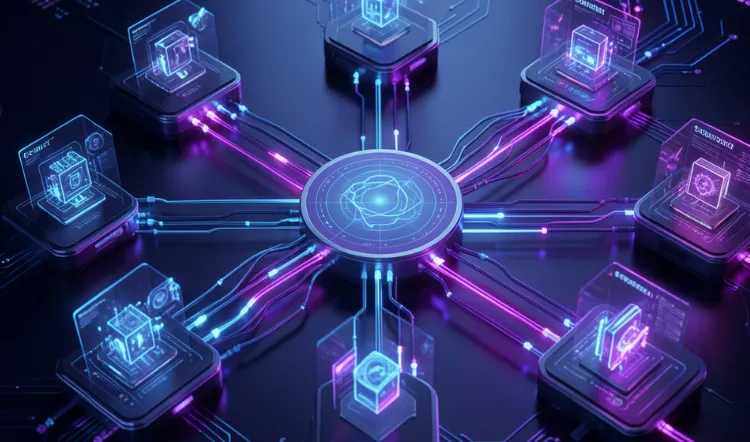
AI agent orchestration provides a framework for coordinating specialized AI agents so they can work toward a shared objective. Instead of expecting one system to handle every task, organizations can assign different responsibilities to different agents and coordinate their activities through a central workflow.
As a result, businesses can create more flexible digital operations while allowing employees to focus on activities that require creativity, judgment, and strategic thinking.
How AI Agent Orchestration Works
The process begins when a business gives an AI system a goal or task. An orchestration layer then determines what needs to happen and which specialized agents are best suited to complete each part.
For example, one agent could collect information, another could analyze the data, and another could prepare a response. Meanwhile, an orchestration system can monitor the workflow, transfer information between agents, and determine what should happen next.
Consequently, complex processes can become a coordinated sequence of smaller activities. This approach is particularly useful when a business workflow involves multiple systems, data sources, or decision points.
Why Multiple AI Agents Can Be Useful
A single AI model can perform many different tasks, but specialized agents can provide a more structured approach. Each agent can be designed around a particular responsibility, allowing businesses to create workflows that resemble digital teams.
Moreover, specialized systems can potentially make workflows easier to manage. If one component needs improvement, organizations may be able to modify that part without redesigning the entire process.
This flexibility is becoming increasingly relevant as companies experiment with AI across customer service, finance, human resources, sales, marketing, and IT operations.
The Role of AI in Business Automation
Automation has traditionally relied on predefined rules. However, intelligent agents can introduce greater flexibility by interpreting information and responding to changing conditions.
For instance, an AI driven business workflow could examine incoming customer information, identify the appropriate department, analyze relevant records, and prepare a response. Therefore, employees can spend less time coordinating routine processes.
Technology insights from the evolving AI ecosystem show that automation is becoming more adaptive. Instead of simply repeating a fixed sequence, intelligent systems can increasingly respond to context.
Applications Across Business Functions
The potential applications extend across almost every department. Human resources teams could use coordinated AI systems to organize employee information, support recruitment workflows, and assist with routine communication. These capabilities align with broader HR trends and insights surrounding workplace automation.
Financial organizations could use intelligent agents to support document analysis, reporting, and operational workflows. However, finance teams would still need appropriate oversight for sensitive decisions and regulatory requirements, particularly as finance industry updates increasingly emphasize responsible AI adoption.
Sales teams could use coordinated agents to research prospects, organize customer information, and support follow up activities. This could complement modern sales strategies and research while allowing representatives to focus on relationship building.
Marketing teams may also benefit from AI systems that analyze customer behavior, support content workflows, and identify campaign opportunities. As marketing trends analysis becomes increasingly data focused, coordinated AI workflows could help marketers process information more efficiently.
AI Agent Orchestration and the IT Ecosystem
The growth of AI agent orchestration is closely connected to the evolution of the wider IT ecosystem. Modern organizations already operate across cloud platforms, databases, applications, collaboration tools, and enterprise software.
An orchestration layer can potentially connect intelligent agents with these systems, creating workflows that operate across multiple digital environments. Additionally, APIs and cloud infrastructure make it easier for organizations to connect different technologies.
Nevertheless, integration remains a significant challenge. Businesses need reliable data, appropriate access controls, monitoring systems, and clearly defined responsibilities to ensure AI workflows operate safely.
Challenges Businesses Need to Consider
Although the technology offers significant potential, organizations should not assume that deploying multiple AI agents automatically produces better results. Poorly designed workflows can create unnecessary complexity or produce inconsistent outcomes.
Security is another important consideration. Each connected agent may require access to information or business systems. Therefore, organizations need strong identity controls, permissions, monitoring, and governance.
Human oversight also remains essential. AI systems can make mistakes, misunderstand context, or generate unreliable information. Consequently, businesses should determine which activities can be automated and which decisions require human approval.
The Importance of Data and Governance
Reliable data is one of the foundations of successful intelligent automation. Agents depend on accurate information to make useful decisions and complete tasks effectively.
Businesses should therefore establish clear data governance practices before expanding AI workflows. Access permissions, data quality, privacy requirements, and auditability should be considered from the beginning.
Furthermore, organizations should monitor AI performance over time. Regular evaluation can reveal errors, inefficiencies, and opportunities for improvement.
The Future of Intelligent Business Operations
The development of coordinated AI systems points toward a future where digital agents become active participants in business workflows. Instead of using AI only as a question and answer tool, organizations may increasingly use it to coordinate complex processes.
However, successful adoption will depend on more than technological capability. Companies will need strong governance, employee training, reliable infrastructure, and clear business objectives.
As AI becomes more integrated into enterprise operations, the organizations that benefit most are likely to be those that treat intelligent automation as a strategic capability rather than simply another software feature.
Practical Insights for Business Leaders
AI agent orchestration matters because it changes how businesses can approach automation. Instead of asking one AI system to perform every activity, organizations can coordinate specialized capabilities around a larger business objective.
Leaders should begin by identifying repetitive workflows where multiple steps already depend on digital information. From there, they can evaluate where intelligent agents could provide measurable value while keeping human oversight for sensitive decisions.
The broader lesson is that AI adoption should be driven by business outcomes rather than technology excitement. When intelligent systems are connected to reliable data, clear processes, and responsible governance, they can become a powerful part of digital transformation.
The future of business automation will increasingly depend on collaboration between people and intelligent systems. Organizations that build this collaboration thoughtfully can improve efficiency while creating more adaptable and responsive operations.
Stay Ahead With Business Technology Insights
Explore the latest technology insights, IT industry news, and practical business strategies with BusinessInfoPro.