


Software as a service companies are entering a new phase of competition as artificial intelligence becomes a core feature of business applications. From customer relationship management and marketing automation to financial reporting and human resources, software providers are embedding AI into everyday workflows to improve productivity and deliver more personalized services.
The shift reflects a broader change in enterprise technology spending. According to Gartner, worldwide spending on artificial intelligence is forecast to reach $2.67 trillion in 2026, an increase of 49.5 percent from 2025. This investment is creating opportunities for SaaS companies while raising expectations around performance, security and measurable business value.
AI Is Changing the SaaS Business Model
Traditional SaaS platforms primarily help businesses manage information, automate routine tasks and collaborate through cloud based applications. AI is expanding these capabilities by allowing software to interpret data, generate content, identify patterns and support decisions.
Consequently, software vendors are moving beyond basic automation toward intelligent features that can complete multiple steps within a business process. For example, an AI enabled sales platform can summarize customer interactions, recommend follow up actions and help teams prioritize potential customers.
Moreover, these capabilities allow established providers to strengthen existing products rather than requiring customers to adopt entirely new systems.
Gartner reported in September 2026 that software vendors are increasingly embedding agentic AI into their products. Businesses are using these features to improve operational efficiency, automate workflows and enhance customer engagement.
Enterprise AI Spending Continues to Increase
The financial outlook highlights the growing importance of artificial intelligence across the technology industry.
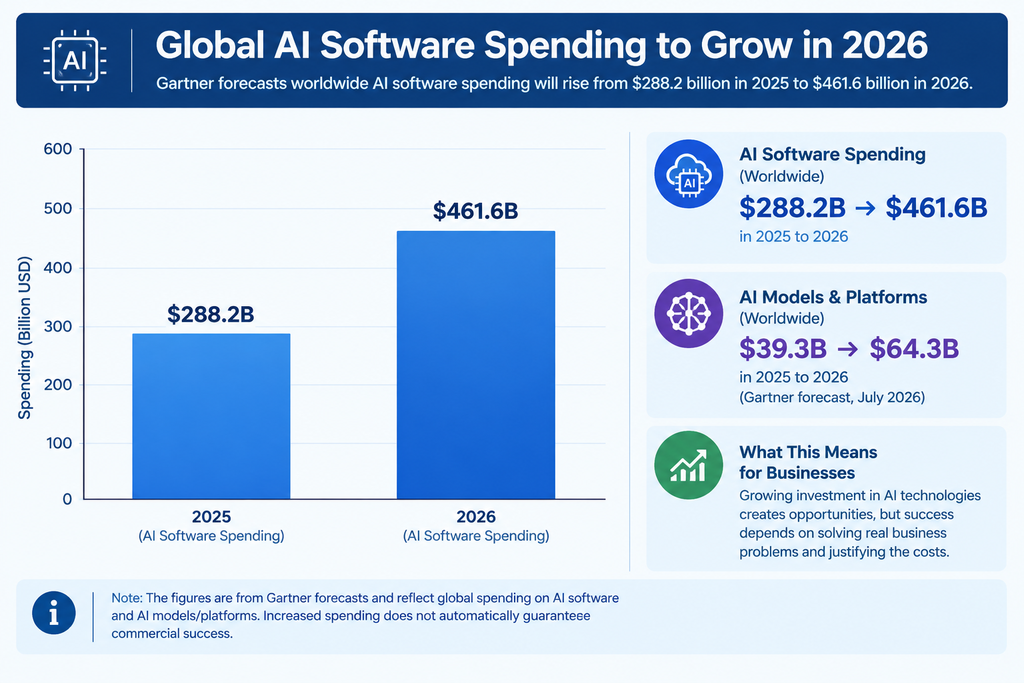
Gartner forecasts that worldwide AI software spending will rise from approximately $288.2 billion in 2025 to $461.6 billion in 2026. This growth reflects increasing demand for software that incorporates AI capabilities alongside traditional enterprise functions.
Furthermore, a July 2026 Gartner forecast projected worldwide spending on AI models and platforms at approximately $64.3 billion in 2026, up from $39.3 billion in 2025.
These figures indicate expanding investment in the technologies that power AI enabled applications. However, increased spending does not automatically guarantee commercial success. SaaS providers must demonstrate that their products solve genuine business problems and justify their costs.
AI Agents Are Expanding Software Capabilities
AI agents are emerging as an important development in enterprise software. Unlike conventional assistants that primarily respond to individual prompts, agents can perform connected tasks within defined workflows, subject to their permissions and level of autonomy.
For instance, an AI agent integrated into a customer support platform could categorize incoming requests, retrieve relevant account information and prepare responses for human review.
Similarly, marketing teams can use AI tools to analyze campaign performance, generate content ideas and identify potential improvements. Finance teams may benefit from automated document processing and transaction analysis, while HR departments can streamline routine administrative work.
Nevertheless, organizations must establish appropriate human oversight, access controls and review procedures before allowing agents to perform sensitive or consequential actions.
Why SaaS Companies Face New Competitive Pressure
The growth of AI is creating both opportunities and challenges for established software vendors.
First, customers increasingly expect AI capabilities to be available within the platforms they already use. Vendors that integrate these features effectively may strengthen customer retention and create additional revenue opportunities.
Second, AI native competitors can challenge established providers by building products around specific workflows rather than adapting older software architectures.
Third, pricing models may change as providers account for model usage, computing expenses and customer demand. Subscription pricing may increasingly include usage based components or separate charges for advanced AI features.
As a result, SaaS businesses must balance innovation with predictable costs and sustainable profit margins. According to Gartner analyst Arunasree Cheparthi, enterprise AI spending is increasingly focused on cost control, usage efficiency and measurable outcomes.
Security and Data Quality Remain Critical
Despite its potential, AI introduces operational risks that SaaS companies cannot ignore.
AI systems may produce inaccurate information, expose sensitive data or generate inconsistent results. Integrations with third party models can also create additional privacy, compliance and security considerations.
Furthermore, AI applications depend heavily on reliable data. Incomplete records, outdated information and poorly structured databases can reduce the accuracy of automated outputs.
SaaS providers therefore need strong data governance, transparent usage policies, appropriate security controls and clear methods for evaluating model performance.
These safeguards are particularly important for businesses operating in regulated sectors such as finance, healthcare and human resources.
What Businesses Should Know
The next phase of SaaS AI growth will depend on how effectively companies translate AI capabilities into practical business results.
Businesses evaluating software should consider the following priorities.
- Measure productivity gains. Evaluate whether AI reduces processing time, improves service quality or increases employee efficiency.
- Review total costs. Consider subscription fees, usage based charges, integration expenses and ongoing maintenance.
- Protect business information. Examine data handling policies, permissions, retention practices and security controls.
- Start with defined workflows. Introduce AI into specific processes before expanding across the organization.
- Maintain human oversight. Require appropriate review for sensitive decisions and high impact actions.
Ultimately, AI is changing how SaaS products are developed, priced and used. Companies that combine useful automation with dependable performance, strong security and clear commercial value will be better positioned to compete as enterprise adoption expands.
Explore the latest business developments and insights at BusinessInfoPro.com.