





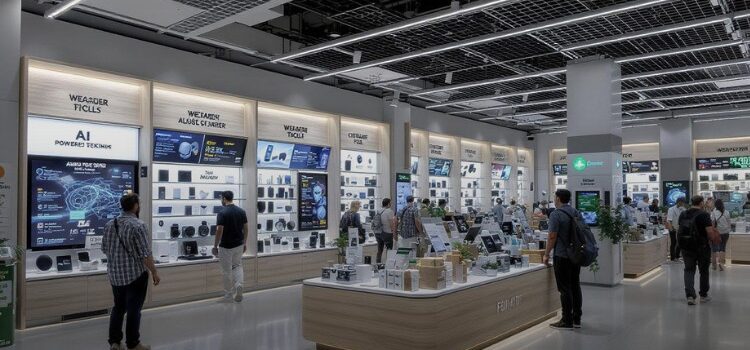
The Consumer Electronics Market once a symbol of innovation, accessibility, and global growth is now standing at a crossroads in 2025. As technology continues to evolve at breakneck speed, manufacturers and brands are grappling with a new era of uncertainty. Economic shifts, changing consumer expectations, sustainability pressures, and rapid AI integration are redefining the competitive landscape.
What was once a steady race for innovation has turned into a complex balancing act between affordability, ethics, and technological relevance. The Consumer Electronics Market is no longer just about producing smarter devices it’s about creating meaningful value in a digital-first world that’s becoming increasingly cautious about consumption.
The Shifting Landscape of the Consumer Electronics Market
In the early 2020s, the Consumer Electronics Market was driven by pandemic-fueled digital adoption, skyrocketing device sales, and the rise of hybrid lifestyles. However, as 2025 unfolds, the growth trajectory has slowed, revealing deeper structural issues.
Inflationary pressures, rising production costs, and tightening consumer spending have hit global sales hard. Markets that once thrived on constant product upgrades like smartphones, wearables, and smart home devices are now witnessing longer replacement cycles. Consumers are becoming more selective, choosing value and longevity over novelty.
Meanwhile, environmental consciousness and sustainability expectations have forced brands to rethink their product strategies. Manufacturers that once prioritized speed-to-market now face the challenge of designing for durability, repairability, and recyclability all without eroding profit margins.
Inflation, Supply Chain Disruptions, and Price Sensitivity
One of the most immediate challenges for the Consumer Electronics Market in 2025 is cost management. Inflation continues to affect raw material prices, logistics, and component sourcing. Semiconductor shortages may have eased, but other dependencies such as lithium for batteries and rare earth elements are creating new vulnerabilities.
Global supply chain disruptions, compounded by geopolitical tensions and regional trade restrictions, have further complicated production and distribution. Manufacturers are shifting toward localized supply chains and dual-sourcing models to reduce risk, but these measures often come at the expense of operational efficiency.
As costs rise, brands are walking a tightrope between maintaining quality and keeping devices affordable. The result? A growing divide between premium innovation and budget-conscious markets, with mid-tier players struggling to maintain profitability.
Consumer Behavior: The Rise of Conscious Spending
Consumers in 2025 are more informed, more demanding, and less impulsive. This behavioral shift is reshaping the Consumer Electronics Market. Today’s buyers evaluate devices not only by performance and design but also by sustainability credentials and ethical sourcing.
According to industry analysts, many consumers are delaying upgrades or turning to refurbished and pre-owned devices, especially in mature markets. Subscription-based models, trade-in programs, and circular economy initiatives are gaining traction as brands attempt to align with consumer expectations.
Additionally, post-pandemic fatigue has reduced the novelty of constant digital upgrades. With many households already equipped with multiple connected devices, the emphasis has shifted from accumulation to optimization. Consumers now seek products that integrate seamlessly, last longer, and adapt intelligently to their lifestyles.
The Role of Artificial Intelligence and Automation
AI has emerged as both an opportunity and a disruptor in the Consumer Electronics Market. On one hand, it powers product innovation from personalized recommendations and adaptive interfaces to predictive maintenance. On the other, it increases development costs and intensifies competition.
In 2025, we’re seeing a new generation of devices built around generative AI and automation. Smart assistants have evolved into intelligent ecosystem managers capable of understanding user patterns, energy efficiency goals, and emotional tone. Yet, while these innovations promise convenience, they also raise privacy and data security concerns that brands can no longer afford to overlook.
AI-driven analytics are transforming manufacturing and customer experience as well. Predictive modeling helps companies optimize inventory, reduce waste, and anticipate demand. However, the challenge lies in ensuring ethical AI governance and avoiding algorithmic bias an area under increasing regulatory scrutiny worldwide.
Sustainability and the Push Toward a Greener Future
Environmental impact has become a defining factor in the Consumer Electronics Market of 2025. Governments and consumers alike are holding companies accountable for e-waste, carbon emissions, and unsustainable production practices.
Major brands are investing in green energy, eco-friendly packaging, and modular device designs that extend product life cycles. Repairability has become a selling point, not a compromise. Meanwhile, regulations like the EU’s “Right to Repair” directive are reshaping how manufacturers approach after-sales service and product longevity.
Circular economy practices are gradually taking root. Refurbishment programs, trade-in offers, and component recycling are not just compliance measures they are central to maintaining brand reputation in a socially conscious marketplace.
Competitive Dynamics and the Innovation Dilemma
Innovation remains the heartbeat of the Consumer Electronics Market, but the cost of staying ahead is higher than ever. With AI, 5G, AR/VR, and IoT converging, differentiation requires massive R&D investments. Only the most adaptive players can maintain the pace.
However, innovation is no longer synonymous with constant new releases. In 2025, it’s about ecosystem integration, software-driven value, and long-term user engagement. Companies like Apple, Samsung, and Sony are focusing on cross-device compatibility and AI-enhanced user experiences, while emerging players compete on affordability and localized innovation.
The challenge lies in ensuring that innovation doesn’t alienate cost-sensitive consumers or exacerbate digital divides between regions. Balancing advanced technology with inclusive access will determine which brands thrive and which fade into the background.
Regional Outlook and Growth Pockets
Despite global headwinds, not all regions are experiencing stagnation. Asia-Pacific continues to lead the Consumer Electronics Market, driven by rising urbanization, youthful demographics, and growing demand for smart appliances and wearables.
In contrast, North America and Europe face slower growth, constrained by market saturation and stricter environmental regulations. Latin America and Africa, however, represent emerging opportunities, with increasing smartphone penetration and expanding middle-class populations fueling demand.
Companies are also focusing on localized marketing, payment flexibility, and service-based models to engage diverse consumer bases across geographies.
The Road Ahead for the Consumer Electronics Market
The road ahead in 2025 is one of adaptation and resilience. The Consumer Electronics Market must redefine success beyond short-term sales metrics. Innovation must coexist with responsibility, and efficiency must align with ethics.
As digital lifestyles evolve, consumer electronics brands will increasingly depend on transparency, sustainability, and AI-driven personalization to stay competitive. Those who can strike this balance between profit, purpose, and progress will emerge stronger in an industry under immense pressure.
As the Consumer Electronics Market continues to evolve in 2025, innovation will define resilience. Leverage AI-powered insights, data-driven intelligence, and scalable strategies with Businessinfopro. Transform how your brand navigates change, engages consumers, and drives growth in a competitive global market.
Source: Nielseniq